Episode 1 | Full Series
Blood Gold
Our search for Colombia’s blood gold takes us to Segovia and the illegal mines at the very beginning of the global supply chain. But what we find there is a strange mirror world, where conventional narratives fall apart, and the names and labels we try to apply do not make sense.
 The mining process
 Las Brisas Mine
 The supply chain
 Transcript
Gallery: The mining process
Segovia’s mines plunge hundreds of meters into the mountain side, where the air gets hot and thick and fights against being inhaled. Each day, the perforadoras, or perforating crews, make holes in the rock face with earsplitting pressurized drills, then pack them with explosives and retreat before the blast sends rocks tumbling and spews a thick cloud of poisonous gas.


The next shift arrives when the dust has settled, but the acrid aftertaste clings to the back of the throat, and a slimy gray layer of sodden dust sticks to the skin. The fronteros, or or pickmen hack at the loosened rock face with chisels and lump hammers.
In tunnels barely wide enough to stretch out and just tall enough to stand, the fronteros shovel the loose rocks into sacks and heave them onto the braced shoulders of the catangueros, or hauler. The sacks weigh upwards of 50 kilos.


The catangueros walk bent over almost at right angles, their knees bulging with every step. While some mines have a rickety old rail cart, most catangueros carry their sacks all the way to the surface, either climbing flimsy and slippery wooden ladders or scrambling up steep tunnels of mud, stone, and low-hanging rocks.
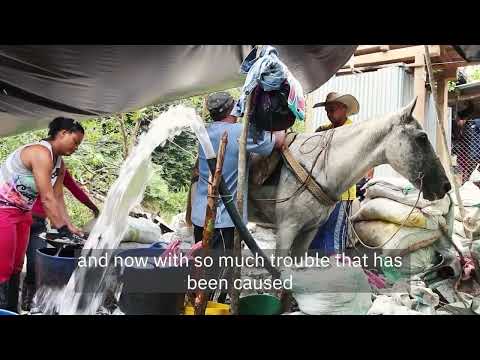
The miners take their ore to rudimentary processing mills known as entables. The entables are found all throughout Segovia, and the town’s streets echo night and day with the clanging of flying cocos – belt-powered cylinders where ore is mixed with water and mercury then ground to sludge by metal balls.


After three hours, the coco is emptied into huge buckets. The watery leftovers run down a canal cut into the floor and out the back of the building, where they join a landslide of sludge known as lodos, or mud.
The miners sift through the solution using a traditional wooden batea, or gold pan, in search of the mercury-gold amalgams forged in the coco. The amalgam is then squeezed into a tight little ball.


The miners hand over their amalgams to gold traders and wait anxiously as they wrap them in crinkled plastic paper to control their heat and stop them exploding, before thrusting them into a gas flame. The gold crumbles into small pans and the mercury becomes fumes released into the air.
Weeks of work and tons of ore become just a few grams of gold. The miners never know how much they will earn for the work they have done until the end of this process.


The residues from this process still contain 40 to 60 percent of the mined gold, which now belongs to the owner of the mill. This is shoveled into huge tanks that churn the mixture for 24 hours with cyanide and other chemicals. The process leaves a lump of gold mixed with other metals leeched from the ore.
Videos

Graphic: The Supply Chain

Most of Colombia’s illegally mined gold is sold to the many gold traders, known as compras de oro, found in mining zones and trading hubs. From there, it must find an entry point into the legal supply chain.

Fraudulent paperwork is then used to pass off the black-market gold as the production of artisanal miners, above all gold panners, or barequeros, or of mines and associations that hold legal mining titles.

The illegal gold is then bought up by exporters. In many cases, these companies buy directly from the gold traders, who launder the gold themselves, or via intermediaries running specialist laundering networks. However, investigations have shown several exporters allegedly set up their own networks of fictious suppliers to launder gold.

Once exported to international refiners, the gold is melted down and mixed together with gold from all over the world to be refined through the smelting process, making it completely untraceable.

The refiners sell to tech companies and jewelers, which use it in manufacturing, and bullion dealers that trade it on commodity markets.
Transcript
Click here to see the transcript | Episode 1: Blood Gold
Mat [00.00.09] It was a gray, drizzly morning in Segovia, a small Colombian mining town balanced precariously on the northwestern tip of the Andes.
And Colombia’s notorious riot police, in black robocop riot gear and black ponchos, were lined up on top of the hill.
Below them was the main picket line set up by the informal gold miners who’d called a general strike. It was lightly manned by a handful of people sheltering under eaves from the rain, but word was getting out, and more began to filter down. Some of them were carrying poles and bats.
The local police commander approached, walking slowly, almost reluctantly towards the workers.
Police commander [00.01.01] Es que la pelea no es con el pueblo. La pelea no es con el pueblo. ¿Y aqui quien esta? El pueblo.
Mat [00.01.07] Your fight is not with the people, and those paying the price are the people,” the official said.
The crowd responded all at once. They started going back and forth, and I couldn’t follow it all, but I heard the commander’s parting shot.
Police commander [00.01.23] Depende de ustedes mismos, muchachos
Mat [00.01.29] “It doesn’t depend on me, everything depends on you, muchachos.”
He paced back up the hill, shaking his head sadly, playing the role of, I gave it all I’ve got, but these guys, they just won’t listen.
And then the riot police moved in.
Filing down the hill in unison, they began to corral the small crowd of tens of strikers. Some strikers stood in the police’s way while pretending like they weren’t. When the police shoved them with riot shields, they threw up their arms as if someone had just spilled their drink in a bar…resisting but still hoping this wasn’t going to happen.
The police herded everyone into the middle of the crossroads, lining us up so we were all directly in front of them. Then they lifted their shields and began to advance.
One of the officers, standing right in front of us, took aim with a gun that shot pellets of pepper spray then fired just to my right.
A youth – clad in black, his face covered by a scarf – leapt at the policeman, clattering a pole into his gun.
Then, all hell broke loose.
From InSight Crime, this is The Shadow of El Dorado, a series about the intricate web of corruption, violence, and complicity behind the gold trade in Segovia, a once-thriving Colombian mining town turned mafia stronghold.
I’m Mat Charles.
James [00.03.27] And I’m James Bargent
Throughout the following 7 episodes, we’ll take you with us on our 8-year-long investigation in Segovia. And we’ll explore the reasons for the town’s descent into an endless cycle of violence, driven by greedy elites, corrupt politicians, gangsters, and warlords.
Mat [00.03.49] Episode 1: Blood Gold
James [00.03.53] We had come to Segovia in search of gold. In a way, our journey was part of a centuries long tradition, a couple of foreigners following in the footsteps of Spanish settlers and British prospectors. But we were looking for a particular type of gold – blood gold.
We study organized crime. And Segovia is an epicenter of Colombia’s billion dollar black market gold trade. It is home to an army of wildcat miners, whose operations are controlled and exploited by mafias and armed groups. And whose gold has supplied some of the biggest brands in the global economy, not only jewelry giants and bullion traders but also technology behemoths like Apple and Microsoft.
Segovia also is, and has been for generations, one of the most violent places in Colombia – a country that has been wracked by civil war and organized crime for decades. And its gold connects us, the consumers of these products, to this bloodshed.
But the story of global consumers complicit in murder, war, corruption, and environmental destruction is, relatively speaking, a simple one – just a matter of working your way up the supply chain link by link.
What made our journey different was that in Segovia, there are no simple stories.
We had not expected our search for blood gold to lead us into a decades old maze of legal battles surrounding a century old mining company. Or to the doorstep of a former aide to a warlord turned gold entrepreneur. Or to a paper trail that connected Segovia’s gold to presidents and billionaire investors.
And we had definitely not expected to get tear-gassed on the front line of a general strike as so-called illegal miners protested against a legal mining company.
Mat [00.05.58] Before we get to the political and criminal intrigue at the heart of this story, it’s important to understand where Segovia’s gold comes from and who is mining it.
Segovia is a mountain town. Its streets roll up and teeter down the green coated Andes, snaking outwards towards peaks and ridges. It all converges in a bustling plaza, which is filled with bars, street vendors, and bored looking police. In the center of the plaza is a statue: a 3-meter-high golden mother earth, naked, manacled, and screaming as her insides are hacked apart by a dead-eyed miner. Segovia, in other words, is a mining town.
Almost all mining in Segovia is subterranean – underground mining. But, there are two – ostensibly very different – mining worlds. There is the legal, regulated, industrial-scale mining carried out by a Canadian multinational mining company. The company, previously known as Gran Colombia Gold but now going by the name of Aris mining, owns a vast mining title covering almost the entirety of the area around the town. And it will own that title forever – thanks to a century old historical quirk, the title is in perpetuity as long as it is in use.
And then there is the other type of mining, which takes place on the edges of that concession. These were the miners whose strike we found ourselves caught up in. They work on a much smaller scale, using rudimentary tools and equipment. The government calls them illegal, or sometimes criminal. The miners prefer ancestral or traditional. The difficulty in finding a label that everyone can agree on is a product of the murky gray area this type of mining operates in, a gray area that was being mercilessly exploited by organized crime.
This was the mining we had come to see.
The first such mine we visited in Segovia was Las Brisas – The Breezes. From what we knew of the town and its bloody gold wars, we half-expected the entrance to Las Brisas to be guarded by stone-faced men clutching assault rifles, or at least tense men with radios to call the men with rifles. But when James and I got there, it was nothing like that.
James [00.08.26] So this is the Las Brisas mine. You walk down a hill towards the mine. The first thing you see is like a little wooden shack. Which is like a café where the workers get their breakfast, their lunch. Then on the left-hand side you see they have a system with a winch to pull up like a cart. They’ve also got a respiratory system that pumps air down into the mine.
Mat [00.08.49] That’s that’s the constant whirring noise that you can hear it’s. It’s the air being pumped down into the mine.
James [00.08.56] And then there is the bocamina, the mine mouth itself is kind of this collapsed rectangle. And it’s not big is it?
Mat [00.09.02] No. I’m surprised at that, I thought it would be bigger. And it’s just black. You can’t see down there at all.
James [00.09.07 Even when you start going down it, You can only just see a few feet in front.
Mat [00.09.11] I’m not looking forward to going down there, to be honest.
We spent a whole shift underground in Las Brisas.
The front where the miners were working was a steep 300-meter descent down a narrow craggy rock tunnel. The air was hot and thick. An acrid damp residue – left over from the explosives they use – clung to the back of our throats. It formed a slimy layer of sodden dust along the rocks. It was hard not to let the claustrophobia set in.
Carlos [00.09.39] Aquí tenemos la veta.
Mat [00.09.43 That is Carlos Durango, the shift leader, better known as Pelo Mula – or Donkey Hair. He is one of several informal miners, as we will call them, you will be hearing from throughout this series. Both the bristly stubble on his head and the name are a family inheritance. He is short and stocky, but moves through the rubble and rock with a smooth, easy assurance.
Carlos [00.10.04] Nosotros aquí buscamos la veta, esa es la veta ya la experiencia de nosotros los mineros ya sabemos que es galena
Mat [00.10.11] Pelo Mula explained how they work the vein – the mining term for the streak of gold running through the mountain rock. The perforating crew drill holes into the rock, plug them with explosives then retreat to set them off, hoping they only bring down the targeted area.
When the dust has settled, the next shift returns to hack the loosened rock face with chisels and lump hammers. They load the loose ore into sacks about the size of a small refrigerator, which they lug over their shoulders – bent at the waist, almost at right angles, their knees bulging with every step.
Jorge [00.10.43] Serían serían dos elevadoras esta que es interna…
Mat [00.10.47] That is Pelo Mula’s half-brother Jorge Sepúlveda, another person you will be hearing from in coming episodes. Jorge was manning the winch that hauls the rickety old rail cart to the surface.
The pair are a study in contrasts. While Pelo Mula is hard living, impulsive, and even a touch reckless – although not when he’s underground – Jorge is diminutive, and, like most miners, compact and muscular. But unlike his brother, he is soft-spoken, thoughtful, and articulate.
Jorge was tucked into a crevice up the shaft from where Pelo and the others were working. That day it was Jorge, but every day a different worker operates the cart. It is the least demanding task in the mine, Jorge told us – and, despite the headache-inducing din of the cart, it is often claimed by whoever comes in with a dire hangover.
Fabian [00.11.46] Si yo en estos momentos acá en Las Brisas soy el administrador.
Mat [00.11.51] Back at the surface we met Fabian Gutierrez, the mine administrator. Fabian is approaching middle age after a good two decades working in the mines, but it doesn’t show.
He is stocky, with a close-cropped head. He strides around the site with a restless energy, shouting and joking with everyone. But his face changes when he is serious, fixing into an intent and piercing stare.
Fabian [00.12.27 Yo aqui en esta mina tengo seis años.
Mat [00.12.33] Like many men of his generation, Fabian began mining when he was still a child. Today’s generation tends to start a little older, but not much – Fabian’s teenage son was with us underground and already working full-time.
Fabian [00.12.45] Porque esta mina tiene mucho tiempo de estar funcionando por ahí, 30 años de estar funcionando
Mat [00.12.51] Fabian told us the story of Las Brisas. How it’s existed for more than 30 years, but was left abandoned when the original prospector died. Then, six years ago, a group of them all chipped in some startup money, cracked it open and put it back to work.
Today, he said, it is one of the best mines in Segovia,
Fabian [00.13.08] Aquí trabajamos como en una familia
Mat [00.13.11] They are like a family, he said.
Las Brisas provides work not only to around 60 miners, but also to about 100 chatarreras, which roughly translates as scrap workers.
The chatarreras sort through the tons of rock discarded by the mine in search of the scraps of gold that remain within. Fabian took us to see their site at the side of the mine opening, where they scrub the rocks down and pluck out those they sense contain a slither of gold.
Fabian [00.13.41] Aca vemos uno de los puestos donde ellas hacen el proceso
Mat [00.13.49] They are almost all women, and most are single mothers, often left abandoned by conflict or crime, or fleeing from domestic violence and toxic masculinity.
Angelica [00.14.04] Aquí en esta mina, un año con tres meses.
Maria [00.14.08] Por ejemplo, yo tengo dos hijos, están estudiando
James [00.14.12] At a nearby mine, we met Maria and her friend, Angelica. The other chatarreras shoved them forward as spokespeople when we asked for an interview, and it is not hard to see why – they like to talk. And they like to laugh, always teasing each other – and us – and seeing the funny side of most situations – even ones that are hard to smile about.
Maria [00.14.35] Aqui en Segovia, siempre he trabajado en eso, desde que yo me conozco…
James [00.14.39] Straining to be heard over the noise of the mine’s ventilators and water pumps, Maria told us how she had been a chatarrera since she was a child, and it was the only work she had ever known. She was supporting two children – on her own.
Maria [00.14.53] Sí, es el sustento para nuestras familias.
James [00.14.57] Both Maria and Angelica want their children to study hard enough so they don’t have to depend on the gold trade.
Angelica [00.15.02] Ese trabajo es muy duro, no tratan a uno como trabajador sino como delincuente
James [00.15.09 It is hard work, Angelica said. But not only that, it gets you treated like a criminal.
Every 15 days or so, the mine’s wealth is divided at the surface according to a clear class system. The first sacks of ore go to the partners: these are the investors and administrators who own a stake in the business – people like Fabian. The rest is divided among the workforce, miners like Jorge and Pelo Mula. Then the chatarreras pack up what are essentially the leftovers.
But from that point, all those sacks of ore, whether they belong to the partners, the miners, or the chatarreras, follow the same route through the supply chain, adding value and generating jobs for Segovia at every link.
To get a better sense of this part of the business, Maria and Angelica let us follow them and their gold on this journey.
From the mines, the ore is taken to one of the processing mills known as entables, which can be found throughout town, in ramshackle single story buildings slotted between homes and small businesses. The mills are dark, dingy, and relentlessly loud. And they smell: a pungent rotten-sweet smell that makes your nostrils flare and your throat gag.
Maria [00.16.36] Recogimos la mina y luego pagamos un arriero en bestia. La traen hasta nosotros. Luego acá venimos, la machamos, la echamos a la macadora,
James [00.16.45] They explain the process to us.
First, the rocks are ground up in a machine called a machadora, a noisy metal box with a conveyor belt running through the middle that feeds the rocks in and the gravel out.
That gravel is added to what’s known as the coco – a belt-powered cylinder that spins with heavy metal balls inside, along with a dash of water and a dose of mercury.
Maria [00.17.14] Lo ponen a moler tres horas. Luego vienen, lo sacan en baldes, echan agüita para que se asiente las aguas,
James [00.17.24] The coco spins for three hours. When it is done, they pour the sludge that comes out at the end into a gold pan, which they shake until they find the silver-gray blob of mercury, which has binded itself to the gold.
Then they repeat, extracting the fragments of gold that may soon be part of a bracelet or an electronic circuit in a cell phone.
The watery leftovers from this process run into a canal cut into the floor and out the back of the building where they join the slumping gray landslide referred to as lodos, or mud. That mud contains as much as 40 to 60 percent of the gold, but it no longer belongs to Maria and Angelica. It is the property of the mill owner now. To get the gold it contains, it is shoveled into huge tanks that slowly churn it up with a cyanide solution. At the end of this process, the toxic waste is dumped down the hillside, leaving a dead zone in its wake.
Angelica [18.24] Salimos más bien pobre. Muy poquito. Era muy poquito.
James [00.18.31] Outside the mill, Maria and Angelica looked frustrated, and not a little worried. They reckoned they had extracted about 12 grams from the scraps they’d brought to the mill, they told us. This was worth about 300,000 pesos, just under $100 dollars at that time. By the time they subtracted their costs – such as tools, transport, and using the mill – they’d be left with about 120,000 pesos each – or around $40 dollars – for two weeks’ work.
All the miners as well as the chatarreras face the same anxious wait each time they go through this process. The wait to know if, for the next couple of weeks at least, they will be rich or poor, whether they can provide for their families, and possibly hit the bars and brothels. As the miners will tell you, most rarely think beyond their next visit to the mill.
Maria and Angelica took their little mercury-laden gold balls to one of the gold traders, who have their own, small storefronts. The traders’ per gram prices fluctuate day by day through mysterious calculations based on everything from global commodity markets to black market trading conditions, and that day’s price was low. They argued with him but had little option but to accept his offer, even though it chipped away further at their already meager profits.
So they handed over their amalgams, which the trader wrapped in crinkled plastic paper – to control the heat and stop them from exploding – then thrust them into the bright blue gas flame. The gold crumbled into small metal pans, and the mercury became fumes we all inhaled.
The mercury from the traders enters the air, into people’s blood streams, and eventually, their DNA. But the mercury is easy to ignore. Once it is burned, it is invisible, and its effects on people’s bodies and minds are hard to pin down.
The other impacts of mining are not so nebulous. In Segovia, the miners have tunneled out the towns’ foundations like termites — shafts on top of shafts alongside shafts that leave Segovia teetering on hollowed ground.
Huge swathes of the town are slowly sinking into the earth. Great fissures rive whole roads. Houses have cracks creeping up walls, snaking along floors and ceilings – cracks so big you can put your hand in and reach through the corner of the house and out into the street.
People in Segovia know the damage done. But they don’t feel like there’s any choice. It is the Faustian bargain behind the town’s very existence: Segovia is a town that was built to be gutted. Gold is its tribute, the price it pays the world for the right to exist.
If you spend any time in Segovia, it is hard to get away from the sense that its gold is cursed and so is the town. Not only has the gold poisoned its earth, its water, and the air itself, it has also corrupted the town’s social fabric, altered the boundaries of morality, and made Segovia … a mafia town.
In Segovia, good men are not always honest men. Bad men help their communities. Legal does not mean moral, while illegal can mean survival. Thieves get government jobs and killers run business empires, while those branded as criminals break their backs in honest labor.
And in Segovia, fear has become a way of life.
During our time in Segovia, we got followed by youths on motorbikes who made phone calls every time we stopped somewhere to record. We got approached by innocuous looking people with strange questions about our day, or who dropped odd details about our movements into conversation. We learned from our connections in nearby towns that in Segovia, they knew who we were; they knew what we were doing; and they knew who we were talking to.
They were the Gaitanista Self-Defence Forces of Colombia – or the AGC, if we use their Spanish acronym – a drug trafficking militia that is one of Colombia’s most powerful and violent armed groups. And, by the time we’d arrived, they controlled Segovia’s gold trade.
We didn’t get to speak to them in Segovia. For that, we had to go to a nearby mining town, where we met with an AGC financiero, or money man.
El Gordo [00.23.25] Me matan esos hijos de puta
That’s next time on the Shadow of El Dorado.
Subtitulado en español
Haga clic aquí para ver la transcipción en español | Episodio 1: Oro de sangre
Mat [00.00.09]: Era una mañana gris y lluviosa en Segovia, un pequeño pueblo minero de Colombia ubicado en el extremo noroeste de los Andes.
En lo alto de la colina, estaba formada la temida fuerza antidisturbios de Colombia, con sus trajes tipo Robocop y ponchos negros.
Debajo, estaba formada la línea principal de la manifestación, integrada por los mineros de oro informales que la habían convocado. Había apenas algunas personas en el lugar que se protegían de la lluvia bajo los aleros, pero corría la voz y empezaban a llegar más. Algunas traían palos y bates.
El comandante de la policía local se acercó a los trabajadores caminando lentamente con un poco de desgano.
Comandante de policía [00.01.01]: Es que la pelea no es con el pueblo… la pelea no es con el pueblo. ¿Y aquí quién está? El pueblo.
Mat [00.01.07]: “La pelea no es con el pueblo. ¿Y quién está aquí? El pueblo”, dijo el comandante.
La multitud reaccionó de inmediato. Se movía de un lado a otro, y no pude seguir todo lo que ocurría, pero escuché la última frase del comandante.
Comandante de policía [00.01.23]: Depende de ustedes mismos, muchachos.
Mat [00.01.29]: “No depende de mí, todo depende de ustedes, muchachos”.
Subió de nuevo a la colina, sacudiendo la cabeza con tristeza, como si estuviera diciendo: “Lo di todo, pero estos tipos simplemente no escuchan”.
Y entonces los escuadrones antidisturbios avanzaron.
Bajaron la colina en formación y comenzaron a acorralar a la pequeña multitud de decenas de manifestantes. Algunos se interpusieron en su camino fingiendo que no lo hacían. Cuando la policía los empujó con los escudos, ellos levantaron los brazos como si alguien les hubiera derramado su bebida en un bar… resistiendo, pero aun con la esperanza de que no pasara a mayores.
La policía nos agrupó a todos en el centro de la intersección, y nos alineó justo enfrente de ellos. Luego levantaron los escudos y comenzaron a avanzar.
Uno de los agentes, que estaba justo delante de nosotros, apuntó con una escopeta que lanza balines de gas pimienta y disparó a mi derecha.
Un joven —vestido de negro y con la cara cubierta con una bufanda— se abalanzó sobre el agente, golpeando su arma con un palo.
Y entonces, se desató el caos.
Esto es The Shadow of El Dorado – La sombra de El Dorado, una serie de InSight Crime sobre la intrincada red de corrupción, violencia y complicidad detrás del comercio de oro en Segovia, un próspero pueblo minero colombiano que se convirtió en un bastión de la mafia.
Soy Mat Charles.
James [00.03.27]: Y yo soy James Bargent.
En los próximos siete episodios, recorreremos juntos los ocho años de investigación en Segovia. Y explicaremos las razones detrás de la espiral de violencia en la que cayó el pueblo, impulsada por élites codiciosas, políticos corruptos, criminales y señores de la guerra.
Mat [00.03.49]: Episodio 1: “Oro de sangre”
James [00.03.53]: Vinimos a Segovia en busca de oro. En cierto sentido, nuestro viaje seguía una tradición de siglos: un par de extranjeros siguiendo la ruta de los primeros españoles y prospectores británicos atraídos por el oro. Pero nosotros buscábamos un tipo particular de oro: el oro de sangre.
Estudiamos el crimen organizado. Y Segovia es el epicentro del multimillonario mercado negro del oro en Colombia. Allí opera un ejército de mineros artesanales cuyas actividades son controladas y explotadas por mafias y grupos armados. Y cuyo oro ha llegado a algunas de las marcas más grandes del mundo, no solo joyerías y comerciantes de lingotes, sino también gigantes tecnológicos como Apple y Microsoft.
Segovia también es, y ha sido por generaciones, uno de los lugares más violentos de Colombia —un país sacudido por la guerra civil y el crimen organizado por décadas—. Y su oro nos conecta, como consumidores de esos productos, con ese derramamiento de sangre.
Pero la historia de consumidores globales cómplices de asesinatos, guerras, corrupción y destrucción ambiental es, relativamente, sencilla: solo hay que seguir la cadena de suministro, eslabón por eslabón.
Lo que hizo diferente nuestro viaje es que en Segovia no hay historias simples.
No esperábamos que nuestra búsqueda de oro de sangre nos condujera a un laberinto de batallas legales que se remonta a décadas atrás, en torno a una empresa minera con más de un siglo de existencia. Tampoco hasta la puerta de un antiguo asesor de un señor de la guerra convertido en empresario del oro. O, incluso, que nos enfrentara a una serie de documentos que vinculaba al oro de Segovia con presidentes e inversionistas multimillonarios.
Y, definitivamente, tampoco esperábamos terminar siendo alcanzados por gases lacrimógenos en medio de una huelga general donde los llamados mineros ilegales protestaban contra una empresa minera legal.
Mat [00.05.58]: Antes de adentrarnos en las intrigas políticas y criminales que están en el corazón de esta historia, es importante entender de dónde viene el oro de Segovia y quién lo está extrayendo.
Segovia es un pueblo de montaña. Sus calles suben y bajan por las verdes laderas de los Andes, serpenteando hacia picos y crestas. Todo converge en una plaza bulliciosa, llena de bares, vendedores ambulantes y policías con cara de aburridos. En el centro de la plaza hay una estatua: una madre tierra dorada de tres metros de altura, desnuda, con grilletes, gritando mientras un minero de mirada vacua le arranca las entrañas. Segovia, en otras palabras, es un pueblo minero.
Casi toda la minería en Segovia es subterránea. Pero existen dos mundos mineros, ostensiblemente muy distintos. Está la minería legal, regulada, a escala industrial, realizada por una empresa multinacional canadiense. La compañía, conocida anteriormente como Gran Colombia Gold y ahora como Aris Mining, posee un título minero que cubre casi toda el área alrededor del pueblo. Y lo posee a perpetuidad —gracias a una anomalía legal centenaria, el título se mantiene mientras se encuentre en uso—.
Y está la otra minería, la que ocurre en los márgenes de esa concesión. Son los mineros cuya huelga nos atrapó. Trabajan a pequeña escala con herramientas y equipo rudimentarios. El gobierno los llama ilegales o incluso, a veces, criminales. Ellos prefieren llamarse mineros ancestrales o tradicionales. La dificultad para encontrar un término aceptado por todos refleja la zona gris en la que operan y que ha sido explotada sin piedad por el crimen organizado.
Esta era la minería que vinimos a conocer.
Mat [00.07.44]: La primera mina que visitamos en Segovia fue “Las Brisas”. Por lo que sabíamos del pueblo y de sus sangrientas guerras por el oro, esperábamos que la entrada de Las Brisas estuviera custodiada por hombres con rostro pétreo y fusiles de asalto o, al menos, por tipos nerviosos con radios para llamar a los que sí portaban los fusiles. Pero cuando James y yo llegamos, no pasó nada de eso.
James [00.08.26]: Esta es la mina Las Brisas. Uno baja una colina hacia la entrada. Lo primero que se ve es una especie de caseta de madera, que es una cafetería donde los trabajadores toman el desayuno y el almuerzo. A la izquierda, tienen un sistema de torno para subir una especie de vagón. También tienen un sistema de respiración que bombea aire hacia el fondo de la mina.
Mat [00.08.49]: Ese es el zumbido constante que se oye. Es el aire que se está bombeando dentro de la mina.
James [00.08.56]: Y luego está la bocamina, la entrada misma de la mina, que parece un rectángulo colapsado. Y no es grande, ¿verdad?
Mat [00.09.02]: No. Me sorprende eso, pensaba que sería más grande. Y es completamente oscura. No se ve nada hacia adentro.
James [00.09.07]: Incluso cuando uno empieza a bajar, solo se puede ver unos pocos metros por delante.
Mat [00.09.11]: Siendo honesto, no espero con ansias estar bajo tierra.
Pasamos una jornada completa bajo tierra en Las Brisas.
El lugar de trabajo estaba a unos 300 metros de descenso empinado por un estrecho túnel rocoso. El aire era caliente y denso. Un residuo acre y húmedo —producto de los explosivos que usan— se pegaba al fondo de la garganta. Formaba una capa viscosa de polvo empapado a lo largo de las paredes. Era difícil no sentir claustrofobia.
Carlos [00.09.39]: Aquí tenemos la veta.
Mat [00.09.43]: Él es Carlos Durango, el jefe de turno, mejor conocido como “Pelo mula”. Es uno de los varios mineros informales —como los llamaremos— que aparecerán a lo largo de esta serie. Tanto su apodo como su barba incipiente son parte de la herencia familiar. Es bajo y robusto, pero se mueve entre los escombros con soltura y tranquilidad.
Carlos [00.10.04]: Nosotros aquí buscamos la veta. Esa es la veta. Ya por experiencia sabemos que es galena.
Mat [00.10.11]: Pelo mula explicó cómo trabajan la veta —el término minero para referirse al filón de oro que atraviesa la roca de la montaña—. El equipo de perforación hace agujeros en la piedra, los llena con explosivos y luego se retira para detonarlos, con la esperanza de que solo derriben el área deseada.
Cuando el polvo se asienta, entra el siguiente turno para picar la roca suelta con cinceles y mazos. Cargan el mineral en sacos del tamaño de una pequeña nevera, que luego transportan al hombro —doblados por la cintura, casi en ángulo recto, con las rodillas tensas a cada paso—.
Jorge [00.10.43]: Serían dos elevadoras. Esta que es interna…
Mat [00.10.47]: Ese es Jorge Sepúlveda, medio hermano de Pelo mula, y otra de las voces que escucharás en los próximos episodios.
Jorge manejaba el torno que sube el viejo vagón oxidado hasta la superficie. Los dos no podrían ser más distintos. Mientras Pelo mula es impulsivo, recio, incluso un poco temerario —aunque no lo sea cuando está bajo tierra—, Jorge es más bien pequeño, compacto como la mayoría de los mineros, pero habla en voz baja, es reflexivo y elocuente.
Jorge estaba metido en un rincón del socavón, en el que Pelo y los otros mineros trabajaban. Ese día le tocó a Jorge, pero cada día, un minero distinto se encarga del vagón. Es la tarea menos exigente en la mina, nos dijo Jorge. Y, pese al ruido ensordecedor, suele ser reclamada por aquel que llega con una resaca terrible.
Fabián [00.11.46]: Sí, yo en estos momentos, acá en Las Brisas, soy el administrador.
Mat [00.11.51]: En la superficie, conocimos a Fabián Gutiérrez, el administrador de la mina. Fabián está cerca de la mediana edad, después de dos décadas de trabajar en las minas, pero no se le nota.
Es fornido, con el pelo muy corto. Recorre el sitio con gran energía, gritando y bromeando con todo el mundo. Pero su rostro se transforma cuando se pone serio, y su mirada se vuelve fija e intensa.
Fabián [00.12.27]: Yo aquí en la mina tengo seis años.
Mat [00.12.33]: Como muchos hombres de su generación, Fabián empezó a trabajar en la minería cuando era un niño. Hoy, los jóvenes comienzan un poco más tarde, pero no mucho. Su hijo adolescente estaba con nosotros bajo tierra y ya trabajaba a tiempo completo.
Fabián [00.12.45]: Porque esta mina tiene mucho tiempo de estar funcionando… por ahí 30 años.
Mat [00.12.51]: Fabián nos contó la historia de Las Brisas. Cómo había estado activa por más de 30 años y fue abandonada cuando el fundador murió. Luego, hace unos seis años, un grupo de trabajadores reunieron algo de capital, la abrieron y la pusieron a funcionar de nuevo.
Hoy, dijo, es una de las mejores minas de Segovia.
Fabián [00.13.08]: Aquí trabajamos como familia.
Mat [00.13.11]: “Son como una familia”, dijo.
Las Brisas no solo da empleo a unos 60 mineros, sino también a unas 100 chatarreras, que podrían traducirse como recolectoras de desperdicios.
Las chatarreras hurgan entre las toneladas de roca desechadas por la mina en busca de los restos de oro que aún pueden contener. Fabián nos llevó al lugar donde trabajan, junto a la entrada, donde lavan las piedras y seleccionan las que creen que aún contienen alguna partícula del mineral.
Fabián [00.13.41]: Acá vemos uno de los puestos donde ellas hacen el proceso.
Mat [00.13.49]: Son casi todas mujeres, y la mayoría son madres solteras, muchas de ellas desplazadas por el conflicto o víctimas de violencia doméstica y de género.
Angélica [00.14.04]: Aquí en esta mina, un año con tres meses.
María [00.14.08] Por ejemplo, yo tengo dos hijos, están estudiando.
James [00.14.12]: En una mina cercana, conocimos a María y su amiga Angélica. Las demás chatarreras las empujaron al frente como voceras cuando pedimos una entrevista, y no fue difícil entender por qué: les gusta hablar. Y les gusta reír, siempre se están tomando el pelo la una a la otra, sacando el lado divertido a muchas situaciones, incluso las más duras.
María [00.14.35]: Aquí en Segovia siempre he trabajado en eso, desde que yo me conozco…
James [00.14.39]: María, intentando ser escuchada sobre el ruido de los ventiladores y las bombas de agua de fondo, nos contó que había sido chatarrera desde que era una niña y que era el único trabajo que conocía. Mantenía ella sola a dos hijos.
María [00.14.53]: Sí, es el sustento para nuestras familias.
James [00.14.57]: Tanto María como Angélica quieren que sus hijos estudien lo suficiente para no depender del oro.
Angélica [00.15.02]: Este trabajo es muy duro. No tratan a uno como trabajador sino como un delincuente.
James [00.15.09]: “Es un trabajo duro”, dijo Angélica. Pero además de eso, te tratan como a un criminal.
Cada 15 días, más o menos, la riqueza que sale de la mina se reparte en la superficie siguiendo una clara jerarquía. Los primeros sacos de mineral van a los socios: los inversionistas y administradores que tienen una participación en el negocio —personas como Fabián—. El resto se distribuye entre los trabajadores, mineros como Jorge y Pelo mula. Luego, las chatarreras recogen lo que, esencialmente, son los restos.
Pero a partir de ahí, todos esos sacos, sean de los socios, de los mineros, o de las chatarreras, siguen la misma ruta a lo largo de la cadena de suministro, agregando valor y generando empleo en Segovia en cada eslabón.
Para entender mejor esta parte del negocio, María y Angélica nos permitieron seguirlas a ellas y a su oro en ese recorrido.
Desde las minas, el mineral se transporta hasta los entables, los molinos de procesamiento que están por todo el pueblo, instalados en edificios de un piso, encajados entre viviendas y pequeños comercios. Los molinos son oscuros, húmedos y ensordecedores. Y tienen un olor penetrante, dulzón y rancio que irrita las fosas nasales y provoca arcadas.
María [00.16.36]: Recogimos la mina y luego pagamos un arriero en bestia. La traen hasta nosotros. Luego acá venimos, la machacamos, la echamos a la machadora…
James [00.16.45]: Nos explican el proceso.
Primero, las rocas se trituran en una máquina llamada machadora, una caja metálica ruidosa con una cinta transportadora que lleva las piedras hacia adentro y saca la grava al otro lado.
Esa grava se agrega a lo que llaman el coco —un cilindro giratorio impulsado por motor que contiene bolas de metal, un poco de agua y una dosis de mercurio—.
María [00.17.14]: Lo ponen a moler tres horas. Luego vienen, lo sacan en baldes, echan agüita para que se asiente…
James [00.17.24]: El coco gira durante tres horas. Cuando termina, vierten el lodo que sale al final en una batea, que agitan hasta encontrar una masa gris plateada de mercurio, que se ha adherido al oro.
Y luego repiten, extrayendo los fragmentos de oro que pronto podrían formar parte de una pulsera o de un circuito electrónico en un celular.
El agua restante de este proceso corre por un canal en el suelo hacia la parte trasera del edificio, donde se une a un alud gris y espeso conocido como lodo. Ese lodo puede contener entre el 40% y el 60% del oro, pero ya no les pertenece a María ni a Angélica. Ahora es propiedad del dueño del molino. Para extraer ese oro restante, el lodo se arroja en grandes tanques donde se remueve lentamente con una solución de cianuro. Al finalizar, los residuos tóxicos se vierten cuesta abajo, dejando a su paso una zona muerta.
Angélica [18.24]: Salimos más bien pobres. Muy poquito. Era muy poquito.
James [00.18.31]: Afuera del molino, María y Angélica lucían frustradas y un poco preocupadas. Calculaban que habían logrado extraer unos 12 gramos del material que habían llevado. Eso equivalía a unos 300.000 pesos colombianos, poco menos de 100 dólares en ese momento. Tras restar sus costos —herramientas, transporte y uso del molino—, les quedaban unos 120.000 pesos a cada una, alrededor de 40 dólares, por dos semanas de trabajo.
Tanto los mineros como las chatarreras enfrentan la misma espera ansiosa cada vez que repiten este proceso. La espera para saber si, al menos durante las próximas dos semanas, serán ricos o pobres, si podrán mantener a sus familias y quizá celebrar en los bares y burdeles. Como dicen los propios mineros, casi nunca piensan más allá de su próxima visita al molino.
María y Angélica llevaron sus pequeñas bolitas de oro mezclado con mercurio a uno de los compradores de oro, que tienen sus propios pequeños locales. El precio por gramo fluctúa diariamente, basado en cálculos misteriosos que combinan desde el mercado internacional hasta condiciones del mercado negro.
Discutieron con el comprador, pero no tenían más opciones que aceptar la oferta, aunque eso recortará aún más sus ya escasas ganancias.
Entregaron sus amalgamas, que el comprador envolvió en papel plástico arrugado —para controlar el calor y evitar que explotaran— y las puso sobre una llama azul intensa. El oro se fundió en pequeñas bandejas de metal, y el mercurio se convirtió en humo que todos inhalamos.
Ese mercurio liberado por los compradores entra al aire, al torrente sanguíneo de las personas y, eventualmente, a su ADN. Pero es fácil ignorar el mercurio. Una vez que se quema, es invisible, y sus efectos en el cuerpo y en la mente son difíciles de rastrear.
Otros impactos de la minería son menos etéreos. En Segovia, los mineros han horadado los cimientos del pueblo como si fueran termitas —ejes sobre ejes junto a otros ejes, que dejan al pueblo tambaleándose sobre tierra hueca—.
Grandes zonas del pueblo se están hundiendo lentamente. Grietas profundas parten calles enteras. Las casas tienen fisuras que suben por las paredes, recorren los pisos y techos —grietas tan grandes que uno puede meter la mano y asomarse al otro lado, hacia la calle—.
La gente en Segovia sabe del daño. Pero siente que no tiene opción. Es el pacto fáustico que define la existencia del pueblo: Segovia es un lugar construido para ser saqueado. El oro es su tributo, el precio que paga al mundo por existir.
Si pasas tiempo en Segovia, difícilmente escapas de la sensación de que su oro está maldito y el pueblo también. El oro no solo ha envenenado la tierra, el agua y el aire. También ha corrompido su tejido social, ha difuminado los límites de la moral, y ha convertido a Segovia… en un pueblo mafioso.
En Segovia, los hombres buenos no siempre son honestos. Los malos ayudan a su comunidad. Lo legal no siempre es moral, y lo ilegal puede significar supervivencia. Los ladrones consiguen puestos en el gobierno y los asesinos dirigen imperios empresariales, mientras los que son señalados como criminales se parten la espalda trabajando honradamente.
Y en Segovia, el miedo es parte de la vida cotidiana.
Durante nuestra estadía en el pueblo, nos siguieron jóvenes en motocicleta que hacían llamadas cada vez que parábamos a grabar. Se nos acercaron personas de apariencia inocente con preguntas extrañas sobre nuestro día o que, de pronto, dejaban caer detalles sobre nuestros movimientos. Nuestros contactos en pueblos cercanos nos confirmaron que en Segovia, ellos sabían quiénes éramos, ellos sabían qué estábamos haciendo y ellos sabían con quiénes hablábamos.
Ellos eran las Autodefensas Gaitanistas de Colombia (AGC), una milicia narcotraficante que es uno de los grupos armados más poderosos y violentos del país. Y, cuando llegamos, ya controlaban el comercio de oro de Segovia.
No logramos hablar con ellos en Segovia. Para eso, tuvimos que ir a un pueblo minero cercano, donde nos encontramos con un financiero de las AGC, un encargado del dinero.
El Gordo [00.23.25]: Me matan esos hijos de puta.
Pero eso lo encontrará en el próximo episodio de La Sombra de El Dorado.
Credits
Written and reported by: James Bargent
Produced by: Mathew Charles
Executive producers: Steven Dudley and Elisa Roldán
Script editing by: Tatiana Lozano, Steven Dudley, and Elisa Roldán
Sound design and editing by: Valentina Fonseca
Graphic design by: Isabella Soto and Juan José Restrepo
Art Direction by: Elisa Roldán
Fact checking by: Beatriz Vicent Fernandez


Did you enjoy this episode?
We want our content to remain free. Please consider donating to support our work. Every little bit helps.
Listen on: