

Episode 7 | Full Series
War Stories
We head back to Segovia after several years away. Has the town been able to escape the blood gold cycle?
 Transcript
Case Files: The Gran Colombia Gold Lawsuit
Click on the arrows to follow the paper trail

Gran Colombia Gold’s lawsuit against the Colombian government began with this notice of intent letter, sent to the Directorate of Foreign Investment and Services in the Ministry of Trade, Industry and Tourism. In the letter, the company outlines how, in its view, the government has failed to protect its assets from an invasion of illegal miners. Specifically, it argues the illegal miners are stealing the company’s gold, evading taxes, trashing environmental and labor standards, “violating the fundamental rights of those working in these areas,” and creating “an environment of economic informality that leads to crime, money laundering, insecurity.” Gran Colombia also complains the government has failed to protect the company from “so-called ‘strikes,’ through which groups of illegal miners have blockaded public and private roads,” and “armed violence, guerrilla activity and criminal bands, threats to employees and contractors.” 
The claim was filed under the terms of the Colombia-Canada Free Trade Agreement, which the company argued the government was violating by favoring its own investments over Canadian capital. The damages the company claimed include lost income from illegal mining and the suspension of activities due to strikes, threats, and violence; security costs in the absence of state protection; administrative costs stemming from legal actions against illegal mining; and damage from attacks against company infrastructure. The total bill for these damages, it says, is $700 million. But, the company made clear, the costs would continue to accrue unless the government “puts an end to the illegal occupation of the Mining Titles.” The letter ends with an invitation to “settle this claim amicably” through “consultations and negotiations.” Instead, the case was passed to the World Bank’s International Centre for Settlement of Investment Disputes.
 See all the documents here
Case Files: The Frontino War Crimes Case
Click on the arrows to follow the paper trail

The Special Jurisdiction for Peace (Jurisdicción Especial para la Paz – JEP) was created as a transitional justice mechanism to help facilitate Colombia’s peace process with the guerrillas of the Revolutionary Armed Forces of Colombia (Fuerzas Armadas Revolucionarias de Colombia – FARC). Its brief, however, extends far beyond the FARC’s conflict with the state; the JEP can hear cases related to any crimes committed within the context of Colombia’s civil conflict. In 2019, representatives of the Frontino workers and pensioners filed a petition arguing the JEP’s mandateshould include the “the blood-and-fire dispossession of Frontino Gold Mines Ltd in the municipality of Segovia, Antioquia, using supposedly legal mechanisms to dispossess this company from its true owners (workers and pensioners).” 
The basis of this argument was that the legal struggles over Frontino were backed by a violent paramilitary campaign targeting the company’s workers, unionists, and anyone calling for Frontino to be turned over to the workers and pensioners. As evidence, the report detailed cases covering a 30-year period, running from the alleged complicity of the Frontino management in the 1988 massacre of 46 people to the capture of former Frontino liquidator, Eduardo Otoya, for his paramilitary ties in 2016. It also names 47 members of the union that were murdered, along with others who were disappeared, displaced, or who survived attacks. 
Their case doesn’t end with the sale of Frontino. The report alleges that after Gran Colombia Gold took over, “the company’s macabre intentions became evident as it began to outsource production through contracts with third-party companies, violating all labor rights to the point of making in-kind payments, granting work contracts to paramilitaries who threatened, displaced, attacked, and murdered personnel for claiming their labor rights.” 
The filing ends with a call for the JEP to determine the facts, provide justice and reparations for the victims, and to ensure they no longer face threats and violence. It also provides the JEP with a long list of people whose roles in the Frontino saga should, according to the plaintiffs, be investigated. At the top of that list is former President Álvaro Uribe.
See all the documents here
Transcript
Click here to see the transcript | Episode 7: War Stories
James [00.00.05] In the grainy footage, the group of youths, their faces covered, are showing off an arsenal of homemade explosive devices.
“The Segovian people are not to be played with. If you want war, war’s what you’ll get” one says.
It was eight months after we got tear-gassed covering the Segovia miners strike, and the town had gone on strike again. This time, neither Mat nor I could get out there. But soon, sources began sending us frantic messages and passing us videos of disturbing scenes on familiar streets. This was one of those videos
“We’ve got everything. To the riot police, the same weapons they use against us, we will use against them”, says one while the person filming pans the camera to show the name of Segovia’s mayor spelled out in dynamite.
The first videos had been of marching riot police and fleeing crowds. Then came the flaming barricades, torched houses, and rocks raining down on armored police trucks as explosions lit up the night sky.
Then… things really escalated. A lone policeman raising a rifle and appearing to fire on unseen targets. Riot police wounded by an explosion, writhing in a hospital bed. A twitching youth sprawled out on the street, blood pouring from an open chest wound. They were snapshots of a town spiraling out of control.
The governor of Antioquia, the northwestern Colombian state where Segovia is located, justified the police violence with claims that the strike had been infiltrated. There were two strikes going on, he said, a peaceful strike by artisanal miners, and a violent strike by armed groups.
He was not completely wrong. We heard from those in the thick of it that both leftist guerrillas and the criminal paramilitaries of the Gaitanista Self-Defense Forces of Colombia, known as the AGC for their Spanish initials, were stirring the chaos and feeding the violence. But there were not two strikes, no neat line between criminal and legitimate, peaceful and violent. The miners had had enough. They didn’t need criminals or militias to tell them that.
It felt like the line in the sand moment we’d been hearing about since we started this investigation, was finally here. Surely, this was it, Segovia’s breaking point, the moment when everything would change, for better or for worse.
It went on for 43 days. But when the miners, the state, and the company finally came to an agreement to bring it to an end, that agreement looked… pretty much like every other agreement we’d seen to that point. Maybe the details were different, but the aims, objectives, pledges and methods all looked numbingly familiar.
We thought we’d be back to Segovia soon enough to find out what was going on, within a few months maybe. But those months turned into years. And by the time we finally made it back to Segovia, we didn’t know what to expect.
From InSight Crime, this is The Shadow of El Dorado, a series about the intricate web of corruption, violence, and complicity behind the gold trade in Segovia. And the story of how this once-thriving Colombian mining town became a mafia stronghold.
I’m James Bargent.
Mat [00.03.55] And I’m Mat Charles. This is the final chapter in this series. Episode 7: War Stories.
The first thing we saw on the mountain road descending into town was a landscape that had been transformed. Gran Colombia Gold, the Canadian multinational that has the legal rights to Segovia’s gold, had left its mark while we had been away.
James [00.04.27] So, we are just up the hill from the El Silencio mine. And this has changed a lot. I mean, when we first came here, this was basically like a green, idyllic little valley with the Frontino cottages just dotted around the top…
Mat [00.04.44] …the little stream that kind of ran through the middle. And this is where Leonel brought us, right? To meet his friends, to show us the people that were living in the houses. And this is what all of them were telling us about. This is what all of them were worried about, that they were going to be kicked out and that this valley was going to be turned into… Well, what is it?
James [00.05.02] They set up a new processing plant here for the gold from El Silencio. But, it’s just, they decimated the landscape. It’s just a big crater, basically, filled with tailings from the mine, filled with rubble. So this is likely the waste material after the process and it still has all the chemicals, like the cyanide, and the other chemicals they add to extract the gold. And it’s just this great toxic sludge.
Mat [00.05.35] And that was not all that had changed.
After a bit of wandering around, we tracked down the new office of the mesa minera, or mining roundtable, the organization that represents Segovia’s informal miners. There we met Jaime Gallegos, the mesa vice president and strike organizer from the last episode.
When we asked Jaime what had been going on since we were there last, he immediately went back to the strike, the second one, the one where they had lost control. It had been, in its own way, a breaking point. But not quite how we’d been expecting.
Jaime Gallegos [00.06.30] Eh, que ha surgido de ese paro para acá? Pues nosotros; era la esperanza de que era la solución con los acuerdos firmados. Pero no.
Mat [00.06.37] They had been hopeful they’d finally find some solutions after signing the agreements that brought a stop to the fighting, Jaime told us.
Jaime Gallegos [00.06.45] Se firmaron unos acuerdos, pero acuerdos que no fueron cumplidos. Si.
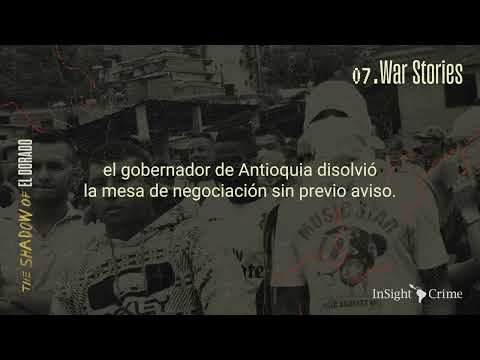
Mat [00.06.51] But once again, there had been little progress and both sides remained entrenched. Then, on his last day in office, the Governor of Antioquia dissolved the negotiating table with no warning. And they hadn’t talked to the company in the two years since.
In the absence of talks, the company had taken a new line of attack, and a pretty brazen one considering what we found out over the course of this investigation.
Jaime Gallegos [00.07.17] La Gran Colombia se dedicó a demandar penalmente a los mineros. El 80% de los mineros están demandados por cinco delitos; patrocinadores a grupos al margen de la ley.
Mat [00.07.30] Gran Colombia Gold had been pressuring prosecutors to bring criminal charges against the mines for, among other things, financing armed groups, Jaime told us.
Jaime Gallegos [00.07.40] Y la fiscalía del Gobierno los toma como patrocinador al grupo al margen de la ley.
Mat [00.07.44] When the miners have to pay off armed groups, he said, the prosecutors treat them as sponsors of organized crime.
Jaime Gallegos [00.07.51] Las multinacionales supuestamente también hacen lo mismo, pero para la multinacional, el gobierno y la fiscalía lo toma como lo extorsionaron.
Mat [00.07.59] Miners working for Gran Colombia, though, supposedly do the same, but then the company is seen as a victim of extortion.
That wasn’t the only criminal charge the company was pushing for, there were five in total. One that really made Jaime bristle was the charge of environmental crime. Since we’d been away, the informal miners had made a big push to lower their use of mercury. And all the while, the company had been building the huge processing plant and tailings pit we’d seen on our way into town.
Jaime Gallegos [00.08.31] Por eso nosotros decimos que nosotros no somos los depredadores del medio ambiente en Segovia y Remedios, sino que la Gran Colombia.
Mat [00.08.39] They displaced a whole neighbourhood of families, Jaime said. They knocked down the houses, destroyed the streams, cut down the trees. It was the company, not the informal miners, that was preying on the environment, he added.
But the miners weren’t the only ones the company was going after through the courts. It was also using the Colombia-Canada Free Trade Agreement to sue the Colombian government for not protecting their assets from illegal miners and armed groups. The company had demanded $700 million in damages.
Jaime didn’t seem to take any pleasure in the bitter irony. He just sounded exasperated.
Jaime Gallegos [00.09.19] Se fueron a favor de las multinacionales y desprotegieron a los mineros colombianos. Estas multinacionales cogieron un poder inmenso que mandan más que el mismo Estado.
Mat [00.09.30] The state had favored the multinationals and left Colombia’s miners unprotected, he said, and now those companies had gained immense power and were ordering the state around like it were on the company payroll.
Jaime Gallegos [00.09.43] Y no mandaría ni presidente, ni fiscal, ni el Presidente de la República, sino se le dio tanto poder que ellos son un Estado sobre el Estado.
Mat [00.09.54] They gave so much power to the multinationals, that the companies are now their own state above the state, he added.
Mat [00.10.04] We arranged to visit Las Brisas mine in the hope of catching up with Fabian and the brothers Jorge and Pelo Mula, the Segovian miners who we followed throughout this series. Fabian was out of town, but Jorge and Pelo Mula agreed to meet us after their shift.
They were still underground when we arrived, so while we were waiting, we got a tour of the mine’s latest edition – an onsite processing mill. The new mill was different to the ones we had seen before – it extracted the gold from ore without using mercury.
Miner [00.10.38] Acá admiren el nuevo molino. Que esa es la minería limpia. Eso es lo que se llama minería limpia. Vamos hacía la mineria limpia.
Mat [00.10.47] This is what they want to do, the miner giving us the tour told us, practice clean mining at Las Brisas. When Jorge and Pelo emerged from the mine, we sat down with them for a coffee at the little shack café where the miners got their meals. Jorge picked up where our tour guide had left off.
Jorge [00.11.05] Hemos mejorado la tecnología. Para trabajar mejor, más limpio, para trabajar como nos mandan las normas. Sin contaminar menos, y tratar de cuidarnos nosotros también.
Mat [00.11.15] This had been the biggest change at Las Brisas since we were last there, Jorge told us, their work to improve their technology. The idea was to work better and cleaner, to work within the regulations, not only to contaminate less but to take care of themselves as well. What they wanted, he said, was for all this to be sustainable, for it to support them into the future. But the new tilt towards sustainability couldn’t mask the fact that the future seemed as precarious as ever. Jorge and Pelo Mula told us how since the breakdown in talks with Gran Colombia, Las Brisas had been involved in a legal battle over the mine’s right to exist. There had already been several hearings, a site visit by a judge. They were waiting for a ruling but, they said, were already prepared to keep fighting on the strange foreign ground of the courts until they had exhausted every last appeal.
But this was not their world, not their rules. And if at the end of it all, the ruling went against them, well, then that would not be the end of it all.
Pelo Mula [00.12.20] Se supone que eso va a pasar acá, porque esa es la consigna de todos los mineros. Si se cae una, caen todas. Nosotros, los mineros de Segovia, todos, ninguno marca que caiga ni uno.
Mat [00.12.30] “If one mine falls, they all fall” – that was the miners’ slogan now, Pelo Mula told us. And if they tried to close one down, then everyone would fight back.
Pelo Mula [00.12.40] No nos vamos a entregar. Entregamos la vida primero que a toda la minería.
Mat [00.12.44] “We’ll give up our lives before we give up mining,” Pelo Mula said. It was a belief forged in the last strike, he explained. The town was shut down for more than 40 days as they battled police, but there was always food for everyone, always some farmer or retailer donating a cow, a pig, some oil or rice, he told us.
Pelo Mula [00.13.04] ¿Entonces qué aprendí? Que somos un pueblo unido, que aunque estamos en distintas minas, cuando nos toca luchar, estamos todos juntos.
Mat [00.13.13] “I learned that we are a united people,” Pelo Mula said, “That when we have to fight, we are all in it together.”
But the battle with Gran Colombia was not the only conflict we wanted to ask them about. Since we were last there, yet another gold war had broken out. A new group had emerged from the pool of criminals left by the paramilitary demobilization, which was still churning out new generations a decade after the far-right militias had stood down. This time, they called themselves the Liberators of the Northeast.
The name was like a grim echo through time: the first paramilitaries to arrive in Segovia, the death squad that had massacred 46 people back in 1988 had been called Death to the Revolutionaries of the Northeast. More than 30 years later and a peace process later, history kept repeating itself.
The objectives of the Liberators of the Northeast were the same as ever: they wanted to drive out their enemies– in this case the AGC – and claim Segovia’s gold for themselves.
The fighting had not been as intense as previous rounds, certainly not reaching the horrifying peaks of the AGC’s war with the Rastrojos which we covered earlier in the series. But it had dragged on for years, sporadically erupting with new atrocities.
The latest had come a couple of weeks before we arrived, when the dismembered body of a 17-year-old had been found packed into plastic bags with a note signed by the AGC. Shortly after, a video of the boy being tortured to death circulated on social media.
Both Jorge and Pelo Mula seemed more exhausted than scared when they talked about it.
Pelo Mula [00.15.03] Pues, no mejoró nada, no mejoró nada. Y todo ello es por la búsqueda del territorio, porque ellos buscan los territorios donde haya abundancia de dinero. Llega el uno, llega el otro y uno siempre va estar en el medio.
Mat [00.15.17] Nothing had gotten any better, Pelo Mula told us, they keep coming, looking for territories where there is money and killing to lay claim to them. A lot of people had caught a bullet or watched someone die. That’s just normal, he said.
Once again, the miners were caught in the middle of it all.
Jorge [00.15.33] Entonces a uno le toca hacerse el de la oreja mocha, el del oído sordo. No hemos visto nada, ni nadie. Ni a usted, ni al otro. Porque sabemos que eso pasa en todo el país
Mat [00.15.43] Both sides had come to demand their tribute – and to demand that the miners didn’t pay the other side. And so they had to play deaf and dumb, Jorge said, they saw nothing, not one side, nor the other. Because they know all too well what happens to people who talk about what they have seen in Colombia.
James [00.16.02] It was clear to us that both Segovia’s social conflict and its criminal conflict had entered new cycles. Or perhaps, more accurately, they had been recycled. Because the differences were in the details alone.
But what had gone before had not gone away. Segovia’s gaping wound from the sacking of Frontino Gold Mines – the story we have explored throughout this series – was still not close to healing.
Before we left for Segovia, we tried to get in touch with the old Frontino unionist, Leonel Carvalho. But he didn’t reply to our texts and when we rang, his phone went straight to voicemail.
When we messaged his old friend Guillermo Velez, we found out why. I’m sorry to tell you, Guillermo wrote back, but Leonel died last year.
Mat [00.16.57] Looks like Leonel’s house is still there, though, look at the top, it’s that one, isn’t it?
James [00.17.00] Yeah you’re right.
Mat [00.17.05] Yeah. But you can tell they’re Frontino houses, because of the red roofs.
James [00.17.11] When we got to town, we went up to Leonel’s old house to see if we could find out a bit more about what happened.
James [00.17.35] His neighbors told us how the cleaning lady had found Leonel passed out in his bathroom. He’d had an aneurysm. He was taken to hospital, but never regained consciousness. We later learned that he had just returned from a public hearing on Frontino in Medellín, where he had broken down, shouting and crying inconsolably.
After the news about Leonel, it was a relief to find Guillermo still as irrepressible as ever.
But while he was alive and well, he had his own story to tell.
Guillermo had by this time left Segovia for Medellín. He was in town to take care of some business but it would be a short trip. To explain why, he took us up to what had been the neighborhood of old Frontino cottages where he had been living when we last spoke to him, but was now the Gran Colombia tailings pit.
Guillermo [00.18.44] Mi casa se encontraba al frente de donde estamos en estos momentos. Un sector llamado Ratón pelado.
James [00.18.55] Guillermo pointed out where his house used to be. It was now a toxic moonscape, filled with a deathly, grey sludge. It started when Gran Colombia began construction on the tailings pit, he explained. Company representatives made the rounds, offering to buy residents out of their homes. But Guillermo refused.
Guillermo [00.19.17] Al hacer el reclamo a la empresa, la empresa ofreció dinero por las casas.
James [00.19.24] But as the houses had belonged to Frontino and their legal status was never settled, exactly who had the rights to them was a complicated issue. And while Guillermo had lived in his for years, he wasn’t the only person with a claim to it. And that other person, who hadn’t worked at Frontino and didn’t live in Segovia but had some convoluted family claim, was more than happy to take the money on offer.
Guillermo [00.19.49] Y efectivamente, el hombre me hizo tres visitas para tratar de sacarme de la casa. La última me la hizo acompañado de tres motos más a las 9.00 de la noche porque me venían a sacar a bala. Estaban armados.
James [00.20.05] The man paid him three visits to try to get him out of the house, Guillermo said. The last of them was at nine at night, when three motorbikes carrying a group of armed men appeared at his door. It was the AGC.
Guillermo fled for Medellín, joining the ranks of the millions of Colombians that have been displaced in generations of conflict.
Guillermo [00.20.28] Me lo encontré en Medellín y volví y me repitió las amenazas. Diciendo que yo bajaba a Segovia y que aquí me hacían algo. Yo cuando bajo tengo que tener mucho cuidado. De dónde, con quién estoy y dónde estoy.
James [00.20.45] He told us how when he went back to Segovia, they threatened him again, telling him that if they saw him in town, then something bad was going to happen. “When I come back these days, I have to be very careful about who I’m with and where I go,” he said.
It felt like that whole broken generation of Frontino men that Leonel and Guillermo had been a part of, was fading away, retreating into the history books, or perhaps more accurately, being sucked down into that deathly, grey sludge.
Amazingly, though, the fight over the company was still going on, it had just moved to distant big city courtrooms. To hear about that, we headed back to Medellin to check in with another of the old Frontino men, former Frontino general manager Mario Piedrahita, who we met back in episode three when he talked us through the boxes and boxes of documents he had accumulated over his years in the struggle.
Mat [00.21.54] Mario had been part of the Frontino management, so was never in the union with Leonel and Guillermo. But when we called, he told us to meet him at the miner’s union office in the city center.
The last time we saw Mario, he was leading a legal battle for reparations on behalf of the Frontino workers and pensioners from his house in Medellín. As revealed in earlier episodes, the workers and pensioners claimed the company for themselves based on a document in which the foreign owners left it to them to pay off the owners’ pension and labor obligations. But those promises were never fulfilled, and instead the company was liquidated and its assets sold off to Gran Colombia Gold.
When we asked him how the case was going, he chuckled. Let me tell you about that movie, he said.
Mario [00.22.45] Le contamos esa película. Esa demanda se hizo en el 2012 yo creo que usted sabe, pidiendo lo que nos dejaron de dar desde 1979, que la empresa es nuestra a la fecha. Fuera de eso, los perjuicios morales, económicos…
Mat [00.23.04] Mario explained how they lodged their claim in 2012, demanding the state hand over what they should have handed over way back in 1979 – the company itself – and that then it also pay compensation for economic and moral damages.
After hearing nothing back for nearly a decade, Mario and the union launched a barrage of legal filings, trying to provoke a response. Their lawyer warned them not to, Mario said, saying they would annoy the judges into ruling against them. But they decided after ten years of silence they had little to lose. What happened next was eerily similar to their previous efforts to reclaim the company through the courts over a decade before, which we detailed in episode four. First, they got shunted between different courts, bouncing between jurisdictions. Then, their case was thrown out on a technicality.
Mario [00.23.59] Dicen que el sindicato no puede reclamar por los trabajadores. Que el sindicato no es el indicado. Cuando ¿para que es un sindicato? Por sus trabajadores. Para defender a los trabajadores.
Mat [00.24.12] Although over a 1,000 workers and pensioners had authorized Mario to represent them in the case, their filings had been through the union. And the union, the court ruled, could not represent those workers, Mario told us. “What’s a union for then?” Mario said, still exasperated after all these years.
By this time, though, Mario and the union had already taken their complaint elsewhere. They filed a case with the International Court of Human Rights. And, in what they felt was their best chance, they had also filed a case with the Special Jurisdiction for Peace, better known as the JEP.
The JEP was born out of the 2016 peace agreement with the FARC guerillas as a truth, justice and reparation mechanism. But its scope wasn’t limited to the battles between the FARC and the state and its proxies, it was there for anyone who had suffered as a result of Colombia’s conflict. And that included them. The Frontino story, they were saying, was a war story.
Mario [00.25.13] Para nosotros es un tema del conflicto armado en Colombia, por lo que te decía ahora. Que ellos se aprovecharon del exterminio de la UP para por ahí derecho exterminar a los dirigentes sindicales, a los trabajadores que están reclamando la empresa como propiedad.
Mat [00.25.33] Mario explained to us why, listing many of the events we have explored throughout this series: the paramilitary campaign to exterminate leftists that began with the 1988 massacre; the killings of unionists; the invasion of the El Silencio mine by the paramilitary backed mine robbers known as machuqueros; the warlord Macaco, and his belief he was going to buy the Frontino mines after demobilizing his forces; the handing out of mining contracts to paramilitary associates by a government appointed liquidator who himself would later be convicted of being a paramilitary associate; and the rise of Macaco’s aide, Julio Erazo, as the new company’s biggest contractor. It was all part of the same plan, they were arguing. They – the paramilitaries, the war profiteers, Colombia’s parasitic elites – were after the company, the crown jewel that was Frontino, he explained. And they had been the whole time.
We asked why this was a case for a body essentially set up to investigate war crimes.
Mario [00.26.35] Sí, porque, porque – es muy sencilla la respuesta. Lo que pasa es que en este, en este caso de la Frontino, está metido hasta las agallas el doctor Álvaro Uribe Vélez, Él fue el cerebro maquinador de todo eso.
Mat [00.26.49] Because, Mario replied, of the man who was the mastermind of all of this – former President Alvaro Uribe. Uribe, he said, was in this up to the gills.
As we’ve revealed in this series, Uribe’s shadow falls across this whole sordid saga. It was Uribe’s peace process that led to Macaco negotiating his Frontino deal – and Uribe who appointed Macaco’s associate as his special presidential advisor on the liquidation process. When the sale of Frontino was faltering, it was Uribe’s government who reached out to the investors working with Frank Giustra, a man Uribe had met through former US President Bill Clinton. And when the sale went through, it was Uribe’s allies that got lucrative executive and board positions.
Uribe is known in Colombia as a war president, the man who drove back the guerrillas at any cost. And this, Mario and the Frontino men were arguing, was part of that cost. Even if the ruling goes against them, though, Mario, the union, and what remains of the Frontino men, will not let this go.
Mario [00.28.01] Como que una rabiecita interna le va dando como así pues es que esto, que es una cosa que es legal y que es lógica y por puro, por pura corrupción no se va a dar.
Mat [00.28.15] They have this anger inside, he said, that this was pure corruption, and it has left people hungry, sick, and dying without any recognition of their rights. That, Mario said, is what gives them the strength to continue.
James [00.28.36] For their JEP filing, Mario and the union had woven all of Segovia’s traumas into one story that explains everything. Looking back on it that way, it looked plausible – another conspiracy of power. But doing this investigation, we got close to many of those stories, spoke to the people involved, dug up the case files, court rulings, and commercial registries. And whenever we had, the idea of a conspiracy, which required planning, coordination, and organization, began to unravel into chaos and opportunism.
This was a war story, alright, a classic of the genre in one of the most war-torn countries in the world. But not the type you see in the movies or on TV, or even in history books. This was a real war story, and real war stories are about chaos and opportunism. It was a real war story because the poor killed each other while the powerful got rich. Because no one in this story was really innocent – but nearly everyone was a victim. Because nothing was clear, there were no easy answers, and no obvious solutions. Because no one really remembers exactly how it all started … and because it never really ends.
And it is gold that has kept this war alive all this time, paying its bills and driving its combatants ever onwards to the next battle. Because there is only one thing that has never stopped and never changed throughout it all: the flow of Segovia’s blood gold from this Andean mountain range all the way to our phones and our jewelry.
Subtitulado en español
Credits
Written and reported by: James Bargent
Produced by: Mathew Charles
Script editing by: Tatiana Lozano, Steven Dudley, and Elisa Roldán
Executive producers: Steven Dudley and Elisa Roldán
Sound design and editing by: Jairo Pineda
Graphic design by: Isabella Soto and Juan José Restrepo
Art Direction by: Elisa Roldán
Fact checking by: Alejandra Rodriguez


Did you enjoy this episode?
We want our content to remain free. Please consider donating to support our work. Every little bit helps.
Listen on:

Share this content
Credits
Written and reported by: James Bargent
Produced by: Mathew Charles
Executive producers: Steven Dudley and Elisa Roldán
Script editing by: Tatiana Lozano, Steven Dudley, and Elisa Roldán
Sound design and editing by: Jairo Pineda
Graphic design by: Isabella Soto and Maria Isabel Gaviria
Art Direction by: Elisa Roldán
Fact checking by: Alejandra Rodríguez
Did you enjoy this episode?
We want our content to remain free. Please consider donating to support our work. Every little bit helps.
Listen on:

