Extra Episode | Full Series
He Met a Pilgrim Shadow
In March 2025, the leader of Segovia’s informal miners, Jaime Gallego, disappeared. A week later, his body was found dumped on the roadside. There was no doubt about who killed him – it was them – the criminalized paramilitaries that run Segovia’s gold trade. But why?
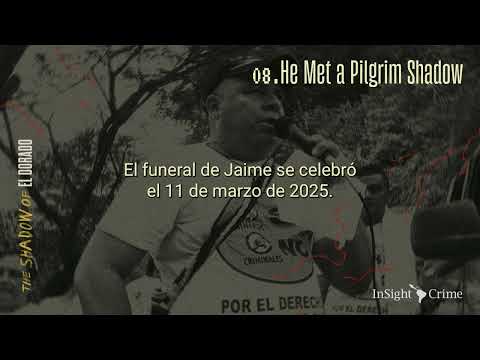
 Jaime Gallego, vice president of the Mesa Minera
 Transcript
Video: Jaime Gallego, vice president of the Mesa Minera

Transcript
Click here to see the transcript | Episode 8: He Met a Pilgrim Shadow
James [00.00.01] On March 27, we ran the final episode of the Shadow of El Dorado, our podcast series exploring the issue of blood gold through the story of Segovia, a mining town in Northwest Colombia. If you have listened, you know the situation in Segovia is perpetually volatile, so it came as little surprise there had been new developments in recent months, developments we felt we couldn’t ignore.
The day we launched this series, February 27, I sent a message to Jaime Gallego, the leader representing informal miners in their struggles against the Canadian multinational that owns the title for Segovia’s gold – today called Aris Mining, but formerly known as Gran Colombia Gold. We had followed Jaime and his work for years, and he features in the last two episodes – so I wanted to let him know that this story was finally coming out.
It had been a while since I’d spoken to him, so I asked him how things were in Segovia.“Harder every day,” he texted. “But always with the will to fight.”
He must have said this or something similar to me many times in the past. I felt sure that if I’d have been there with him, he would have said the same thing but with an exhausted sigh – and maybe also a mischievous smile.
So I didn’t read too much into it. Jaime being Jaime, Segovia being Segovia.
But that would be the last time I would hear from Jaime.
From InSight Crime, this is The Shadow of El Dorado, a series about the intricate web of corruption, violence, and complicity behind the gold trade in Segovia. And the story of how this once-thriving Colombian mining town became a mafia stronghold.
I’m James Bargent. This is a special extra episode: He Met a Pilgrim Shadow.
James [00.02.01] We were a couple of weeks into this series’ run when I got word from Segovia that the mesa minera, the organization set up by Jaime and others to represent the town’s informal miners, was planning yet another strike to protest how the miners, who were the backbone of the local economy, were getting vilified by the government.
The date had been set for March 10. But then on March 4, I received a statement put out by the mesa. Jaime had disappeared.
The day before, he had set out from Segovia with his bodyguard, heading to the nearby town of Vegachi. At around 9.30 a.m., he messaged someone on WhatsApp. And then… silence.
I had met Jaime the very first time I went to Segovia, ten years ago. After that first meeting, we’d followed him on his crusade to protect the small-scale miners, accompanying him as he led marches and made speeches, hovering around as he negotiated with the company or local authorities, and trailing him as he led the town into a general strike.
Throughout this time, we got to know him well enough to see through his gruff exterior. He could come across as combative and surly. But the man we knew was also funny, and big-hearted. So it was a shock to see a picture of Jaime attached to one of the disappeared notices that are issued from Colombia’s conflict zones with chilling regularity.
For six anxious days, Segovia kept vigil in the town square, lighting candles around the base of the monument to the 46 killed in the paramilitary massacre of 1988.
Jessica Vasquez [00.03.47] Porque la incertidumbre de saber si regresan o no a casa, cada día se hace más grande.
James [00.03.53] Every second that passed only increased their uncertainty, their fear, mesa representative Jessica Vasquez told local media. They were keeping the candles lit all night, haunted by the image of Jaime and his bodyguard showing up in the dark, looking for them, she added.
Jessica Vasquez [00.04.10] Así queremos a nuestros amigos en casa.
James [00.04.13] “We want our friends home”, she said.
Then came the news everyone had been dreading. But also silently expecting. The news that had felt inevitable ever since he went missing.
News anchor [00.04.27] Solo a diez minutos del casco urbano de Vegachi, en la vereda el Jabón, fue encontrado sin vida y con impacto de bala el cuerpo del líder social Jaime Gallego, presidente y fundador de la mesa minera de Segovia y Remedios.
James [00.04.39] They had found Jaime’s body.
Exactly what happened remains unclear. But from statements put out by officials and reporting by Colombian media, we managed to sketch out at least a preliminary version.
It began when the Gaitanista Self-Defense Forces of Colombia – the AGC – called Jaime to a meeting at Vegachi. As we have explored throughout this series, the AGC are the criminal masters of Segovia, and the overseers of its gold trade.
According to one report, members of the group had shown up at his house to make the arrangements. To make sure he understood that attending the meeting was not voluntary, they had reeled off the names, addresses and movements of his wife, children, and granddaughter.
The day of the meeting, Jaime was travelling in a car provided by Colombia’s National Protection Unit, which provides equipment and bodyguards to people threatened by armed groups. The car’s GPS signal showed it made it to the outskirts of Vegachi, an hour or two from Segovia, before its tracker was turned off.
Then, in the early hours of the morning of March 9, Jaime’s body was found dumped on a roadside by soldiers investigating reports of shots fired. What they did with Jaime between abducting him and murdering him is still unclear. But reports say his body showed signs of torture – broken ribs and fingers.
His bodyguard, who appears to have been held apart from Jaime, was given the keys to his car and set free. He sped away, ending up in the police station of a nearby town.
It was haunting to think about. Hard not to picture Jaime going through that nightmare. And, sat so far away, hard to imagine what everyone in Segovia was going through as a result.
I wanted to hear from those in town, so I called up Yarley Marín. Yarley had been Jaime’s right-hand man, and he stepped in to lead the mesa minera after his death.
Yarley Marín [00.06.52] El 25 teníamos programado un plantón. Plantón que se realizó el 27 de febrero. Y luego de ese plantón se anunció que la fecha para el paro era el diez.
James [00.07.05] It began when they announced that they would be going on strike at a protest on February 27, he told me.
Yarley Marín [00.07.11] El día del plantón él nos dijo: Me citaron a una reunión, esta gente. Pero no le preguntamos cuál gente.
James [00.07.15] That same day Jaime had told them that he had been summoned to a meeting by “them”, Yarley told me. Jaime didn’t say which “them” it was, the AGC or their rivals, the guerrillas of the ELN; or the FARC dissidents. But from the criminal map, there could be little doubt. Vegachi is AGC territory.
Yarley Marín [00.07.36] Porque nosotros fuimos tajantes, le dijimos no vaya a esa reunión.
James [00.07.39] The other members of the mesa were blunt with him, Yarley said. They told him not to go. But he wouldn’t listen. They knew who killed Jaime. But they were as confused as I was as to why.
The AGC made money off all sides of mining, legal, illegal, industrial, artisanal, everything in between, everything above and below, before and after. Their only interest is in keeping the gold moving along the supply chain so they can take their cut at every step.
Yarley Marín [00.08.09] Claro, para nosotros es muy extraño, porque es que esos grupos siempre han estado ahí y nosotros nunca tuvimos problema con ellos. De hecho, de una u otra manera, pues no sé, no es bueno decirlo, pero hemos aprendido a convivir con estos grupos en los territorios.
James [00.08.24] It is strange, Yarley said, because these groups have always been there and they have never had problems with them. It might not be a good thing to say, he said, but the mesa minera, like the informal miners they represent, have learned to coexist with them.
Yarley Marín [00.08.39] Pero… diez años y estos grupos ya estaban en territorio. ¿Porque hasta diez años después vienen a meterse con Jaime? Pues seguramente ellos lo raptaron, lo llevaron, pero algún interés por encima de ellos estuvo ahí.
James [00.08.55] They had been in this fight for ten years, and these groups had been there the whole time, so why now, he asked? They took him, that much is sure, but there is some other interest above them in all of this, he said.
I asked Yarley about the strike. Surely the timing there was no coincidence.
Yarley Marín [00.09.14] No, el paro en este momento es que, que teníamos planteado porque teníamos planteado obedece a una problemática con el gobierno nacional, que es el tratamiento de criminales que son los que más nos están estigmatizando.
James [00.09.30] But here’s the thing, Yarley answered, the strike was nothing like the ones we’d seen. It wasn’t just a Segovia thing, it was all of Northeast Antioquia. And the miners weren’t planning to shut down the whole town, just block off one road that is a major regional transport artery. What’s more, it wasn’t against the multinational, it was against the government, and – here’s the kicker – against the government’s criminalization of the miners: the destruction of their equipment, the seizure of their gold… and the endless stigmatization.
Despite the timing, Yarley found it hard to look past their conflict with the multinational.
Yarley Marín [00.10.13] Realmente para nosotros todo esto obedecía a la lucha con la multinacional. Obviamente que ahí se sumarían otros intereses, pero toda la problemática que ha tenido la Mesa Minera Segovia Remedios y el trabajo que hizo Jaime en los últimos diez años es en contra de la multinacional.
James [00.10.30] Obviously there are other interests involved, he said, but this is what Jaime had spent the last ten years working on.
It was a sobering thought, and one that made Yarley pause and reflect.
That decade of work had kept mining – their sort of mining – alive in Segovia. But nothing more. They had not made any progress beyond clinging on for survival.
Yarley Marín [00.10.54] Estamos igual que hace diez años. No ha cambiado nada.
James [00.10.57] “We are in the same place as ten years ago, nothing has changed,” he said.
Jaime’s funeral was held on March 11. Someone sent me a video of the procession shot from a balcony: It shows the hearse carrying Jaime’s coffin as it crawls through the streets, surrounded by a crowd all dressed in white, hundreds of people stretching out of sight. Music plays, Segovia flags fly. And there, swaying to the beat, is a Gigantona.
The Gigantona is one of Segovia’s most cherished traditions. It usually takes place during the annual gold festival, a week-long party of music, parades… and lots of drinking.
The Gigantona is a giant whirling girl puppet. At the end of every gold festival, she gets chased through the streets being pelted with fake blood by a half-naked, day-drunk throng. She is eventually abandoned in the town square, battered and covered with streaks of red. The revelers then disperse into the party, drinking and dancing through the night in fake-blood-soaked clothes. And by the end, the streets run red.
Jaime used to organize the Gigantona parade, overseeing the construction of each year’s sacrificial doll in the rundown community center where the mesa had its office. It was typical of the man – not only of his tireless commitment to his community, but also his genuine love for a town that, from the outside at least, seems hard to love.
Most people in Segovia don’t think too much about the tradition of the Gigantona, they don’t even seem to know why it happens, it is just something the town does. But it has a purpose. It is to remember the dead, the Segovian lives claimed by Colombia’s wars. And although the tradition existed before, for the last three decades it has been inextricably linked to the memory of November 11, 1988, the day a paramilitary death squad came for them all.
Jaime knew what the Gigantona represented. He was there that day in 1988. Jaime was a survivor.
One time, Jaime had walked us round the town square, describing the horrors he’d witnessed in a blank monotone.
Jaime Gallego [00.13.47] Bueno, ese 11 de noviembre del ‘88, a eso de las 6.20 de la tarde yo me encontraba tomándome la mediecita en el quiosco principal.
James [00.14.01] He showed us the bar where he had been sitting – and where he saw a bullet hit a court clerk who was passed out drunk against a pillar. Jaime remembered how the arc of blood had shot from his mouth as the clerk slumped down dead. He pointed out the corner where he saw two young men cowering, trying to protect a young girl with nothing but their arms and their desperation.
Jaime Gallego [00.14.24] Y uno de ellos le dijo a los otros “Velos ahí, dale vos, que yo ya no tengo munición”. Inmediatamente les dio un rafagazo y quedaron muertos, acá, la niña y los dos muchachos.
James [00.14.36] He remembered how one of “them” called out to the others “Get them! I’m out of ammo.” And he remembered the burst of gunfire that followed.
But for all the horrors Jaime saw that day, it was something that he would see afterwards that seemed to haunt him the most. It was all there in the drawing of a ten-year-old boy done the day before the massacre. It showed it all, Jaime told us, the three trucks, the 30 gunmen, the dead innocents, the blood in the square and the streets. The boy himself among them, expanding dum dum bullets shredding his lungs, he took a whole day to die.
It was death foretold.
Looking back, Jaime’s own death seems foretold. He had reported 23 death threats to the authorities.
But… as we discussed earlier in this series, many of these threats seemed… off. They were signed with strange names of non-existent groups and seemed more focused on Jaime and the mesa’s arguments with the multinational than the business of war or organized crime.
Those threats played with Segovia’s fear. They adopted the tone and vernacular of Colombia’s conflict, speaking directly to the primordial fear Segovians carry inside themselves at all times, knowing that it would trigger generational trauma. They seemed to be trying to blur the line between reality and illusion by conjuring up specters of the very real threats that lurk in the shadows of Segovia.
Maybe that blurring of the lines had convinced Jaime that the risk was illusory, that this was just people seeking an advantage by playing war. Or, maybe, after everything he had seen, he was resigned to the risks, and willing to stake his life for his community.
Jaime was the 48th union member murdered in and around Segovia since the late 70s. And he was the 33rd social leader killed in Colombia so far in 2025.
In Segovia, Jaime will be remembered as much more than a number. But it’s hard to escape the idea that his death, like those that went before him, will change little. The informal miners have little choice but to struggle. The multinational will protect its investments. The paramilitaries will run their business at the point of a gun. Today, gold is worth more per ounce than at any point in history. And the violence and greed – the savage capitalism that it inspires – will endure.
Subtitulado en español
Credits
Written and reported by: James Bargent
Produced by: Mathew Charles
Executive producers: Steven Dudley and Elisa Roldán
Script editing by: Tatiana Lozano, Steven Dudley, and Elisa Roldán
Sound design and editing by: Jairo Pineda
Graphic design by: Isabella Soto y Ana Isabel Rico
Art Direction by: Elisa Roldán
Fact checking by: Alejandra Rodriguez
Additional research by: Alejandra Rodriguez


Did you enjoy this episode?
We want our content to remain free. Please consider donating to support our work. Every little bit helps.
Listen on: