


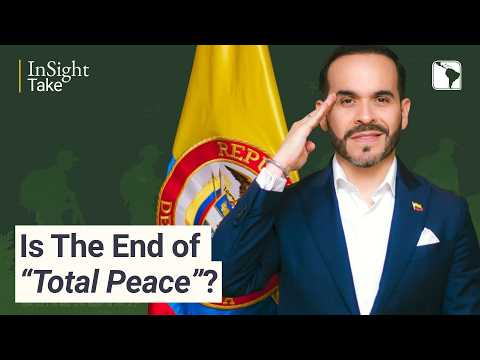
Colombia’s armed groups nearly doubled in size during Gustavo Petro’s Total Peace plan. Managing Editor Deborah Bonello and Co-Founder Jeremy McDermott examine what it actually delivered, and whether President Abelardo de la Espriella’s militarized turn will do any better, when history suggests otherwise.
Total Peace Under Scrutiny
Deborah Bonello: [00:00:01] When Gustavo Petro took office in August 2022, promising to negotiate an end to six decades of conflict, Colombia’s illegal armed groups had a little over 15,000 members between them. When he handed over power last month, they had nearly 29,000. So the groups that he sat down to talk to roughly doubled in size during the time he was talking to them. Now that number is doing a great deal of political work, and it’s being used to argue that the negotiation was naive, that force is serious, and that the militarized reset that we’re seeing from President Avelardo de la Espriella has begun as an obvious correction. I’m Deborah Bonello, managing editor at InSight Crime, and I’m joined by Jeremy McDermott, our co-founder and co-director, who’s been in Colombia for the better part of 30 years, I believe. Jerry the ledgers on Total Peace are closed. But are they being read too quickly?
SEE ALSO: Special Series: Trials and Tribulations of Colombia’s Total Peace
Jeremy McDermott: [00:01:07] Okay, definitely no happy ending for total peace. And it did in no small part, its failures did in no small part lead to the election of De la Espriella. For me, the failures of Total Peace can’t mean that negotiation with armed groups doesn’t work. And there’s plenty of evidence in Colombia to the contrary and successful negotiations.
What Do the Numbers Really Show?
Deborah Bonello: [00:01:35] So we’re kind of going to divide our conversation today into the past, the present, and then throw it forward a little bit. But how solid is that figure in terms of the membership of criminal armies? Because it’s a pretty daunting figure, isn’t it?
Jeremy McDermott: [00:01:52] Yeah. No, it is pretty solid. The figures come from the Defense Ministry’s data and they’ve been analyzed by several NGOs, including Fundacion Para la Paz, which are a pretty serious outfit. I mean, almost doubling in number. I want to say it’s unprecedented. I’m trying to cast my mind back, but it is pretty unprecedented, particularly when we had seen, thanks to two peace processes in the past, numbers really drop. So yeah, it’s a pretty harsh reflection on Petro’s four years.
Deborah Bonello: [00:02:33] Okay, so the numbers themselves aren’t in dispute, but perhaps what they mean is. Let’s go back to before Petro, because I don’t think we can really start to understand what’s happening today before we do that. So start me in 2016 with the signing of the peace accords.
Jeremy McDermott: [00:02:54] Okay. The peace accords were with the Revolutionary Armed Forces of Colombia, the FARC, before Petro, we had President Iván Duque, conservative from the hardline Democratic Center Party. His security policy over those four years, Deb looks a lot like de la Espriella’s security policy now. let’s start with coca. Cocaine, of course, dominates not only the public perception and international perception of Colombia, but its security, the security reality.
The Coca Boom Under Duque
Jeremy McDermott: [00:03:31] When Duque took office in 2018, so the FARC has already demobilized, Colombia had 169,000 hectares of coca, the raw material for cocaine. When he handed over to Petro four years later, it was 230,000 hectares. And the numbers of hectares don’t really tell the full story, Deb, because coca bushes grow. The more you leave them, the bigger they become, and therefore the higher the yield per hectare is. And then of course, we’ve seen increased technification of the process. So now the drug labs are able to get more alkaloid out of the leaves. So we’ve seen not only the increase in hectarage under Duque, but we saw an extraordinary increase in the yield per hectare. So perhaps it’s better to look at the cocaine production that went from 1,100 tons to more than 1,700 tons during the Duque years.
Deborah Bonello: [00:04:54] So after the 2016 Accords, what went wrong? What was it that contributed to that kind of mushrooming of coca production? Is it, you know, because it the signing of the accords was an extremely significant thing.
Jeremy McDermott: [00:05:14] It was, you know, years in negotiation. Deb, when you look at the accords signed with the Marxist guerrillas of the FARC, it’s a really sophisticated document. It covers… It’s not just a surrender document. It covers all sorts of political, social, and economic stuff. And included in there was a crop substitution policy as well, the idea, because the FARC controlled large amounts of areas where coca was grown. So Duque didn’t fulfill that part of that agreement; he did engage in the most unprecedented in scale manual eradication program. 130, 000 hectares were eradicated. That’s the highest we’ve got. And yet he finishes his administration and hands over to Petro record levels of coca cultivation and cocaine production.
The Starting Point for Total Peace
Deborah Bonello: [00:06:17] So what mindset were the groups in when they sat down with Petro at that point, because there was the crop substitution, but there were all sorts of things that didn’t come through after the 216 promises. So where were they when Petro came in?
Jeremy McDermott: [00:06:40] Petro is elected in no small part off the back of his promise of Total Peace to negotiate with Colombia’s various armed actors and end the six-decade civil conflict. He’s a former guerrilla himself, Deb. He demobilized in 1990, and so the thinking was, if anyone can negotiate peace with former guerrilla groups and all the other armed actors, it’s going to be Petro.
Jeremy McDermott: [00:07:11] He didn’t learn from the previous efforts. He went in unprepared. he didn’t fulfill the FARC peace agreement, which had everyone turning around and going, well, hang on, if he’s not even going to, you know, fulfill previous agreements, if we sign an agreement with him, what kind of guarantee is that that is going to be fulfilled? So I think the first mistake he made was he tried to negotiate with everybody at once., and then he went in really ill prepared.
Deborah Bonello: [00:07:51] So walk me through the architecture of what he did because I believe he passed a law in his first hundred days. Is that right?
Jeremy McDermott: [00:08:00] He tried to pass a law, a legislative framework, to negotiate. Well, he divides negotiations into two parts, Deb. One is with those who are recognized to have belligerent status, as in guerrilla groups, rebel groups. And then there’s all the rest who are criminal groups. So the idea with negotiating with the biggest standing guerrilla army, the National Liberation Army, or ELN, was there would be another FARC-type agreement, which is we’ll negotiate this, it’ll be ratified by Congress, and you guys get your own special agreement with political, social, and economic bits and pieces. The rest of you, we’re going to get a legislative framework. You don’t have political status, but we are going to negotiate things like protecting you from extradition, you don’t have to go to prison, or you don’t have to spend too long in prison, etc., etc. All the things that are a criminal group would want to make it worth them while handing themselves over. He never got that through Congress. He never had a legislative framework, neither for the ELN because the talks never progressed really, and nor for the criminals.
Deborah Bonello: [00:09:17] So then what was he offering them at those negotiation tables if there was no legal construct?
Jeremy McDermott: [00:09:26] He offered them something they all really liked the look of, Deb. He offered them a ceasefire. And this was the other huge mistake. In the past, the successful negotiations, in the early 2000s with the paramilitary United Self-Defense Forces of Colombia, the AUC, and then with the FARC, ceasefires came later. Once you’ve shown real progress, once you’ve made concessions, once we’re reaching a point of accelerating agreement, then the ceasefires came in. Petrol starts ceasefires with everybody, so they’re like, this is good. the security forces aren’t coming for us. And so what do they do? Fighting between the state and the illegal actors drops off. Everyone goes, oh, this is fab. Except they start attacking each other. They’re looking to get control of coca crops, gold deposits, internal movement corridors, departure points for for cocaine shipments. And we see this violence come and of course they’re making plenty of money. And what are they doing? They’re recruiting. And then we go back to that number, which you started with.
Deborah Bonello: [00:10:54] Right. So the violence didn’t stop, really. It just changed.
Jeremy McDermott: [00:10:58] It just changed to criminal on criminal violence as opposed to state on criminal violence.
Deborah Bonello: [00:11:05] And how did Colombians, everyday Colombians feel that? What impact did it have on them?
Jeremy McDermott: [00:11:14] In the countryside, an immediate and real impact, because this is of course where the fighting was taking place, Deb, in the more remote parts of the country. And a lot of the fighting was concentrated in areas which the FARC had demobilized in, and if you like, this was the area that was up for grabs, and this is where we see the ELN, we see the Gaitanistas or the Clan del Golfo, one of the biggest drug trafficking organizations. We see FARC dissident groups spring up. And for most Colombians, it suddenly seems to be like this free for all. There’s fighting, there’s different groups. We’re seeing displacements again. We’re seeing massacres. A homicide rate begins to go up again after years of gradual decline. And Colombians turn around and go: Hang on. This was supposed to be history. This was supposed to be consigned to our history. He’s supposed to be negotiating peace. And unfortunately, all we’re seeing is a growth in violence.
Catatumbo, the Breaking Point
Deborah Bonello: [00:12:15] So tell us a little about Catatumbo, because I feel like that was really kind of the poster child of this particular dynamic.
Jeremy McDermott: [00:12:25] Catatumbo is just on the Venezuela border, Deb. It’s one of the main coca-growing regions in Colombia. And it historically has been shared by different guerrilla groups. The FARC had a presence there. The ELN had a presence. There was a smaller group, the EPL has since disappeared. And for the ELN it was their principal money-making machine. And of course they have the advantage. Or they had the advantage under Nicolas Maduro, now a guest of the US justice system, of a friendly government in Venezuela. And so the ELN decided that the border with Venezuela was going to be their territory. They wanted it all, and they wanted to turn it into an even greater money-making machine. And so they attack the FARC dissidents with whom they’ve been allied beforehand. And what we see is hundreds of rebels gather. Those in Colombia and more cross the border from Venezuela. And Deb, this is this kind of concentration of hundreds of guerrillas is something we haven’t seen since the the early 2000s. You know, this goes back to the bad old days of the civil conflict. And in Catatumbo, in 72 hours, almost 100 people are killed by the ELN going house to house and killing those they accuse of being FARC dissident supporters. And 50,000 people are displaced from their homes. And so Colombia goes: Hang on. We cannot be here again. Petro is put into an almost impossible position. He breaks off talks with the ELN, and if you like, that’s the watershed moment for Total Peace.
SEE ALSO: Border Wars: The ELN and the Takeover of Catatumbo
Deborah Bonello: [00:14:24] So was there anywhere where Total Peace worked?
Jeremy McDermott: [00:14:29] Close to work? Yes. One area was down in the south on the Ecuadorian border. When the peace process with the ELN broke up a unit down there and went, well, hang on, we want to negotiate, and they continued negotiating. They handed over weapons. They were about to move to a concentration zone. One of the FARC dissidents as well, one of the dissident groups, under a guy called Walter Mendoza, several hundred strong also handed over weapons, hundreds of weapons and prepared to move to a concentration zone. So yes. And also trust was built in Medellin, of all places, Deb home, you know, to the Medellin cartel, perhaps the capital of cocaine trafficking in the world. And there we saw gangs all negotiating. There was a huge reduction in extortion. Same in another city, Buenaventura. So there was stuff. The problem was, Deb, that it never got over the line because there wasn’t this legislative framework. And the trust was only just being constructed. And, you know, just before we sat down for this program, of course, de la Espriella, the current president, has axed all of those agreements, the concentration zones, and has put the leadership of these groups up for extradition again. So that’s it. Any hopes for peace are done.
Deborah Bonello: [00:16:11] So to come back to what you were saying at the beginning of our conversation, Jerry, and you were talking about this boom in coca, Colombia’s criminal conflict has largely been framed around that criminal economy. Is that still right, or what are you seeing evolving there?
Jeremy McDermott: [00:16:33] I think cocaine is still the principal earner. And it’s kind of the infrastructure, Deb, that many other illicit activities come under. But gold is also another huge earner. Gold prices record high. Colombia, one of the biggest producers of gold in the world. 70% of Colombia’s gold is either illegally or irregularly extracted, which means it’s passing in no small part through criminal hands. So, yes, it’s a massive earner. Cocaine remains the principal driving force, though.
Deborah Bonello: [00:17:10] And what about extortion?
Jeremy McDermott: [00:17:13] Extortion comes from these criminal groups controlling a specific geographic space and having the power to then turn around and go: Listen, if you want to conduct business in our area, you need to pay us a percentage. And this is mainly historically been a rural phenomenon where the guerrillas and the coca out in the countryside. It’s now also an urban phenomenon in certain parts of the cities, Medellin in particular, which we’ve already talked about, but in the south of Bogota as well, where criminal groups have a pretty strong foothold.
The Limits of the Military Shift
Deborah Bonello: [00:17:55] Okay, so let’s tee up to where we are now, Jerry, and de la Espriella’s whole plan, which, as you said, bears a striking resemblance to Duque’s and rests very heavily on the security forces. So what kind of state do we find Colombia’s security forces in today?
Jeremy McDermott: [00:18:17] Colombia’s security forces are the best in the region, I mean, bar none. That’s what happens when you’ve had 60 years of combat experience, isn’t it? But of course, you know, they’ve been in the front line of the drug war ever since it began, and so we are looking at superbly trained troops and police, great intelligence gathering capacity, and a deep knowledge of the terrain and how to operate on it. Where things are a bit wobbly, Deb is kit and money. There has been a huge budget deficit for quite some time. You know, Covid obviously really under Duque, really, knocked everybody’s finances, it wasn’t just Colombia. But then, under Petro, things didn’t really improve, and he still spent like a bit of a madman. And so de la Espriella has inherited a very weak fiscal position. And under Petro—former guerrilla talking peace—the military really not, you know, a priority for what little money he did have. He was more interested in his social programs. So the military has been underfunded, and suffered enormous morale problems under Petro who sacked loads of generals when he took over.
Jeremy McDermott: [00:19:52] But just to give you an example: Colombia’s got the biggest helicopter fleet in the region, and it needs it, you know, we’re in the Andes Mountains, Deb, if you want to walk across a valley that’s going to take you a couple of days—helicopters, five minutes. So helicopters are absolutely crucial to the mobility of the Colombian security forces and their ability to react to any actions. Out of 53 Blackhawk helicopters, only 13 are battle-worthy at the moment. Out of their big transport, the MI17s, out of the 19, 11 are operational. And this really came into stark focus in the Catatumbo crisis because Catatumbo is in the Andes, really hard to transit by road, and suddenly the security forces realized they just did not have the capacity to react to this one crisis while trying to keep, you know, putting out the fires in the rest of the country. So lack of operational budget. Kit is very much, needs maintenance. And this means that you can’t get the troops to the right place at the right time, and you can’t keep them operational for long periods.
Deborah Bonello: [00:21:23] Right. And we saw during Petro’s administration too, that there was this very kind of volatile relationship between himself and President Trump in the United States. He was eventually personally sanctioned, as well as other members of his family by by the US Treasury. And Colombia itself was decertified on counter-narcotics, which was a real eyebrow raiser in a region where it has always been kind of the US proxy. So now we see de la Espriella taking office. He’s saddled up for the Shield of the Americas alliance that we’re seeing Trump pushing across Latin America. And $1 billion security package has been kind of promised to him from the Trump administration. How much of a game changer is that in terms of what we were just talking about with the state of the security forces?
Jeremy McDermott: [00:22:17] Can we just flip back to the past for a second? Again, Deb, just to put this into context, pre-Petro, we have Plan Colombia signed in 1990, implemented in 2000. The US hands over more than $8 billion over the next couple of decades. So Colombia has heavily relied on US aid for a long time. And even under Petro, there was US aid. But when when President Trump cut all foreign aid, if you remember, which he did pretty soon after coming into office, this hit Colombia as well, and this was one of those, you know, wake up moments where suddenly the flying helicopters didn’t have any fuel because the fuel was all paid for by the United States. And everyone went, whoa, okay. We’re in a bit of trouble. So fast forward, you can’t just rebuild the helicopters overnight and to deploy on long term deployment needs an enormous operational budget. And at the moment, Colombia’s defense budget is sucked up almost in its entirety by the salaries for the soldiers and the pensions for the retired. There is a tiny percentage left for operations, and certainly not the nationwide offensive that de la Espriella has promised to bring Colombia’s armed groups to heel. And just a quick flip back again to pre-Petro: when they did have budget, they still weren’t able to bring all of Colombia’s armed groups to heel. And the only way they did make significant progress was through two peace processes where they negotiated with the two most powerful groups who were then in existence.
Between Rhetoric and Reality
Deborah Bonello: [00:24:25] Right. And as you said, the whole point of our conversation today is that that peace process is well and truly over. And yes, it also warrants saying that what we’re seeing happening today is really a repackaging of what we’ve seen over the last 50 to 60 years in the region. In terms of the US pressure, so what is de la Espriella doing now with the resources that he has? And is anything is anything shifting the needle so far?
Jeremy McDermott: [00:24:59] No. There’s a lot of political theater going on. He caused an enormous scandal there by doing a presidential address with a series of bodies laid out in front of him, people who had been killed in a recent security force operation. There has been an increase—a slight increase—in the rhythm of operations, and certainly compared to Petro at the same time in his administration, because of course he had the ceasefires, and he was negotiating. And the military morale is obviously much higher. They now have a president they trust who’s letting them off the leash. But we’re back to the money issue. And, Deb, we have to remind the audience that Colombia had a pretty serious earthquake, very recently, and, you know, huge damage. Still communities are in a terrible state after that. The government has had to step in and spend quite a lot of money to get them to clear things out, to clear up the debris, to get supply lines open again, etc., etc.. So, there’s a lot of talk about what’s going to be done. We haven’t yet seen anything. Which leads me to go, oh, okay, this is this is something different. And I can see this having an impact.
SEE ALSO: The InSight Take: Abelardo de la Espriella Inherits Colombia’s Fractured Criminal Landscape
Deborah Bonello: [00:26:24] And how have the groups, the criminal groups, on the ground been responding to both the sort of strong talk by the president and also the slight uptick in aggressions from the government?
Jeremy McDermott: [00:26:40] We had one group, one leader over the weekend from one of the smaller paramilitaries, gave an interview saying, oh, come on, I’m ready to hand myself over, for goodness sake, just give me an off-ramp, as he’s being hunted. His number two had just been killed by the security forces, so you can see a bit of desperation there, that people don’t see an off-ramp even if they’re willing. The ELN—pretty unfazed by this. They’re 6,000 strong. They’ve been fighting since the early 1960s, Deb. And so, this is business as usual for them. Some of the bigger drug trafficking groups are alarmed to see that their leaders have been put back on extradition duty, so to speak. We haven’t seen a military pushback, Deb, mainly because there hasn’t really been the need for one yet. It’s not like there really has been a serious offensive that has moved or had to shift the criminal dynamics. Everybody’s still looking to see what the gap between the political rhetoric and the conditions on the ground are going to be. And at the moment, there’s still a lot of daylight between those two.
What History Teaches Us
Deborah Bonello: [00:28:01] Sure. And I’m really keen to hear, you know, what you think. You’ve been there long enough to see both approaches, right? You’ve seen the peace approach, albeit imperfectly executed. And clearly some of those mistakes or, you know, problems with implementing the peace process were fundamental to its success. But now we’re seeing kind of a swing back to doubling down on militarization. What does the record say in terms of what is most effective in creating, you know, generating less violence and bringing more security to Colombia? Let’s leave aside the issue of the existence of the international cocaine business, which is something else.
Jeremy McDermott: [00:28:53] We talked about this a bit in one of the previous InSight Takes on the Shield of the Americas, this militarized approach to transnational organized crime, and we identified some of the more regional responses. But to zoom into Colombia, Deb, I think it’s important to remember in the end of the 90s, there was a real fear that Colombia was going to become a narco-state. You know, the FARC guerrillas were in the outskirts of Bogotá, Medellín, and Cali. There was this right wing paramilitary army. The left and right were battling it out, and the state was an observer for the most part in this. So how did we get from that to relative stability, economic success, you know, Colombia opening up to tourists, all this other stuff that happened, were essentially two peace processes and the use of a big stick, a juicy carrot, and all the organs of the state. So the big stick was, the US come in, billions of dollars of aid, helicopter fleets, highly trained troops, the ability to conduct sustained offensives with really good intelligence. And the FARC turn around and go, okay, we’re not winning this. Suddenly a serious political agreement where we get to Congress, where we can set up a political party, is looking real.
[00:30:40] And the paramilitaries before them are in the same position. Okay, the state’s suddenly strengthening itself. Maybe we aren’t that needed, and also all of us have got extradition warrants to the US, so why don’t we negotiate as well? So we have the big stick. Very effective stick. A stick, by the way, bigger than de la Espriella has now and will likely have after a couple of years, even assuming he’s got the money. But then there’s the really juicy carrot. And the juicy carrot is serious peace agreement, protection from extradition. Plus, we’re going to negotiate the arrival of not just the military, but of health, education, social security. And this is what we saw. Because when I arrived in ’97, Deb, the state wasn’t present in much more than 50% of national territory. That is what changed. And that is what was successful. And if we look at just a military approach, again, I go back to the ELN, but even the Gaitanistas, or the Clan del Golfo, they trace their roots all the way back to the Medellín cartel, and the ELN had been around since 1964. You know, they’re not intimidated by a military approach. They’ve been living, they’ve been shaped, they’ve survived everything the US backed military can throw at them. And guess what? These groups are stronger than they’ve ever been before. And they were stronger than they’ve been before. Even before Petro.
Deborah Bonello: [00:32:17] Mhm.
Jeremy McDermott: [00:32:18] So, you know, I think what is clear is we cannot bomb and shoot our way out of this problem. And that what we’ve seen in Colombia is big stick, juicy carrot does seem to show results.
Deborah Bonello: [00:32:32] Right. And Colombia does have their neighbors in Ecuador to, you know—of course, Colombia’s criminal landscape is particularly complex, but in Ecuador, you know, we’ve seen the militarization campaign by President Noboa now running for a number of years. What do you think de la Espriella’s takeaway from that is, if he if he looks next door?
Jeremy McDermott: [00:32:58] I’m not sure he’s looking that closely because the one quantifiable thing we can say after almost three years of Daniel Noboa’s militarization policy is the homicide rate has gone up. That it’s now one of the highest in South America. I think it is the highest in South America, way higher than Colombia, still in the midst supposedly of a civil conflict. So, yeah, Ecuador is probably not a gleaming example of what can go right.
Deborah Bonello: [00:33:29] Right. Well, in an attempt to not end with everything fails, what’s your verdict moving forward, Jerry? What do you see coming for Colombia, and what do you hope for?
Jeremy McDermott: [00:33:46] Okay. What I would hope for is not anything that de la Espriella, unfortunately, has promised, but an improvement in the security forces, a greater effectivity in operations and the rule of law. And what we haven’t, what hasn’t been promised, but we need to see is the ability to turn this improved law and order apparatus into better citizen security on the ground. And de la Espriella is really light on detail here. All he’s told us is he’s going to hammer the illegal actors. And what history has told us—and I know you want to end on a positive note, Deb, and I can’t help you out—what we’re going to see is, if there is a real military offensive, and I’m skeptical that it will have any serious impact, let’s say it does, what are they going to do? They’re just going, the guerrilla groups and the armed factions are simply going to reduce the military targets that they offer. They’re going to embed themselves yet deeper in the civilian population, and they’re going to literally make military operations impotent by ensuring that if you use them, you’re going to hit civilian targets. And they’ve already done this. They’ve already used civilians as shields. They use civilians to engage the military and and nullify their operational capacity. So we’ve seen it before. We are likely to see it again. And it’s going to be very frustrating for the Colombian people.
Deborah Bonello: [00:35:40] Indeed. Well, we will of course be watching. Not the cheerful note to end on that I was hoping for though, Jerry. But thank you for joining us and thank you all for watching The InSight Take, our weekly video analysis of the biggest crime stories in Latin America. You can find us on our website in the multimedia section, or on YouTube and Spotify. And if there is a story you’d like us to go deep on, please do reach out to me at flagship@insightcrime.org We’ll be back next week. Bye for now.


